



PR

令和維新
2004年4月から企業を離れ、コンサルタントや情報起業を試行しなが ら、失われた20年を取り戻し、日本再生をめざす私の歩みをみて一人でも多くの後継者が出てくれることを祈りつつ友達から紹 介されたこのホームページの更新を続け、これまでの活動の記録と今やビッグデータ、AI,、IOT,ブロックチェーン、仮想通貨の時代になってしまいましたが、私の現状認識と関連技術を紹介していきたい。
「フランスはユーロから脱退するしかない」フランス・デモとギリシャへの道
あなたは株式を取引したいのか、それとも株式をデジタル化した版を取引したいのか。(Do You Want to Trade Stocks or Digitalized Versions of Stocks?)
プラズムの上昇傾向(The Plazm Upside)
(1)(ビットコインが再び暴落している。ほとんどの投資家が常に誤解していることは以下の通りである。(Bitcoin Is Crashing Again. Here’s What Most Investors Always Get Wrong.)
先端技術情報20261007
ソ連は軍事と宇宙開発に予算をつぎ込み、スプートニクで社会主義の成果を誇る一方で、国民は貧困に苦しみ続けた。中国は今、そのスプートニク経済を踏襲中。
ウォーレン・バフェットは市場の暴落を待っていない。彼ははるかに大きな何かを待っている。(Warren Buffett Isn’t Waiting for a Market Crash. He’s Waiting for Something Much Bigger.)
(2)プラズムの上昇傾向(The Plazm Upside)
先端技術情報20261006
Comments
 New!
USM1さん
New!
USM1さん2026年10月8…
New!
藻緯羅さん🍎 新作「アルプスの… New! 神風スズキさん
今日の十月桜 上野…
New!
GKenさん英語に未来時制って…
samito07さんCategory
カテゴリ未分類
(112)連絡
(24)交流会
(27)セミナー
(29)参考情報
(138)オフ会
(36)on-line報告会
(13)翻訳ビジネス
(8)情報開発
(270)ビッグデータ
(89)ブロックチェーン
(255)人工知能
(577)IOT
(309)仮想通貨
(882)コンテンツ
(131)政治経済
(2017)先端技術
(986)DITA
(53)テレワーク
(28)UX
(0)文書管理
(9)テクニカルライテイング
(29)学習
(9)訓練
(1)XMLソリューション
(3)メタバース
(101)Web3
(69)投資
(208)IoT
(34)投資信託
(1)ビットコイン
(842)イーサリアム
(166)NFT
(41)オンライン
(0)受動収入
(14)ソーシャルメデイア
(0)DAO
(2)DeFi
(85)暗号通貨
(168)トークノミクス
(23)アルトコイン
(234)空中投下
(16)スマート契約
(4)ステーブルコイン
(43)金
(5)生成AI
(5)SCM
(4)ウオレット
(9)不労所得
(60)セキュリテイ
(4)ミームコイン
(51)CBDC
(5)PoS
(3)PoW
(1)ETF
(15)仮想通貨ETF
(1)予言
(7)裁定取引
(1)GameFi
(5)マイニング
(11)RWA
(25)DePIN
(22)SWFT
(1)WLFI
(1)アービトラージ
(7)XRP
(69)大統領選
(4)BCH
(1)取引ボット
(17)トレーデイング
(56)不動産
(1)詐欺
(4)貿易戦争
(1)医療
(1)金融
(2)TEZOS
(1)CARDANO
(2)カルダーノ
(3)ステーキング
(5)チェーンリンク
(1)開発
(0)HEDERA
(4)スマートマネー
(0)流動性
(0)AIエージェント
(26)401k
(1)国際送金
(1)solano
(1)AI
(1)暗号資産
(102)機関投資家
(5)量子コンピューター
(8)AIエージェント
(6)ドキュメンテーション
(2)AIトレーデイング
(1)トークン化株式
(2)半導体
(1)フリーランス
(1)Keyword Search
Freepage List


Shopping List

The blockchain analytics industry was built on that question. Chainalysis, the largest firm in the sector, has mapped over a billion addresses, linked $14 trillion in transactions to real-world entities, and signed over $65 million in contracts with more than ten U.S. federal agencies — the FBI, IRS, DEA, ICE, and SEC among them. In 2022, a U.S. District Court recognized blockchain analysis as sufficient basis for probable cause in search warrants. The blockchain’s permanent public record turned out to be exactly what governments needed for financial surveillance at a scale that traditional banking records could never provide.
その問いの上に、ブロックチェーン分析産業が築かれた。最大手のChainalysisは、10億以上のアドレスをマッピングし、14兆ドルの取引を実世界の主体に紐づけ、FBI・IRS・DEA・ICE・SECなど10以上の米連邦機関と6,500万ドル以上の契約を結んでいる。2022年、米連邦地裁は、ブロックチェーン分析を捜索令状の相当な理由として認めた。ブロックチェーンの永続的な公開台帳は、従来の銀行記録では不可能だった規模の金融監視に、政府がまさに求めていたものだった。
The irony is architectural. Traditional banks keep private records that governments must subpoena. Blockchain keeps public records that governments can read directly, permanently, without a warrant, for any transaction that has ever occurred. The ledger that was built to protect you from institutional power became the most comprehensive financial surveillance infrastructure ever constructed, and governments have worked actively to ensure it stays that way.
皮肉は構造にある。従来の銀行は非公開の記録を持ち、政府は召喚状を出さなければならない。ブロックチェーンは公開記録を保持し、政府は令状なしで、永続的に、すべての取引を直接読むことができる。本来は権力からあなたを守るために作られた台帳が、史上最も包括的な金融監視インフラとなり、政府はそれを維持するため積極的に動いてきた。
Privacy-preserving tools — the technologies built specifically to give blockchain users the anonymity that the system’s transparency denies them — have been systematically targeted. Tornado Cash developers were arrested and sanctioned. Mixers have been banned. Privacy coins have faced a wave of exchange delisting, with regulators in Japan, South Korea, the UAE, and the EU all restricting or banning them. In 2025, privacy coin delisting hit the highest number since 2021. Back in 2020, the IRS issued a $625,000 contract bounty for methods to crack Monero’s privacy protocol — and governments have been expanding those capabilities ever since.
プライバシー保護ツール──透明性によって奪われた匿名性をユーザーに取り戻すための技術──は体系的に標的にされてきた。Tornado Cashの開発者は逮捕・制裁され、ミキサーは禁止された。プライバシーコインは取引所からの大量上場廃止に直面し、日本・韓国・UAE・EUの規制当局はそれらを制限または禁止した。2025年、プライバシーコインの上場廃止数は2021年以来の最高を記録した。2020年にはIRSがMoneroの匿名性を突破する方法に62.5万ドルの報奨金を出し、政府はその能力を拡大し続けている
The message is not ambiguous: governments prefer blockchain’s transparency. And they are willing to criminalize the tools that would undermine it.
But the surveillance problem is not only governmental. The blockchain’s permanent public record creates a different category of threat at the individual level, one that has recently turned violent.
しかし監視の問題は政府だけではない。ブロックチェーンの永続的な公開記録は、個人レベルで別の種類の脅威を生み、それは近年暴力に発展している。
In 2025, David Balland, co-founder of Ledger — one of the most prominent names in hardware wallet security — was kidnapped from his home in central France. His captors severed one of his fingers and demanded €10 million in cryptocurrency. Police rescued him after 58 hours. This is the person who built the tool designed to protect you.
2025
年
1
月、
Ledger
の共同創業者
David Balland
がフランスの自宅から誘拐され、犯人は彼の指を切断し、
1,000
万ユーロ相当の暗号資産を要求した。警察は
58
時間後に救出した。これはあなたを守るためのツールを作った人物である。
The mechanism is direct. Blockchain’s public ledger allows anyone who can link a wallet address to a real identity — through an exchange registration, a data breach, a court filing, a social media post — to see the full balance and transaction history of that person. Once identified, a wallet holder becomes a target with a known net worth that can be extracted in seconds, transferred irreversibly, and never recovered. The transparency that enables trustless verification also enables targeted robbery at a precision that cash never permitted.
仕組みは単純だ。ウォレットアドレスを実名と紐づけられる者なら誰でも、その人の残高と取引履歴をすべて閲覧できる。一度特定されれば、その人物は瞬時で奪えて、不可逆で、取り戻せない資産を持つ標的になる。信頼不要の検証を可能にする透明性は、同時に現金では不可能だった精度の強盗も可能にする
The Problems Hidden Inside the Logic
ロジックの内部に隠された問題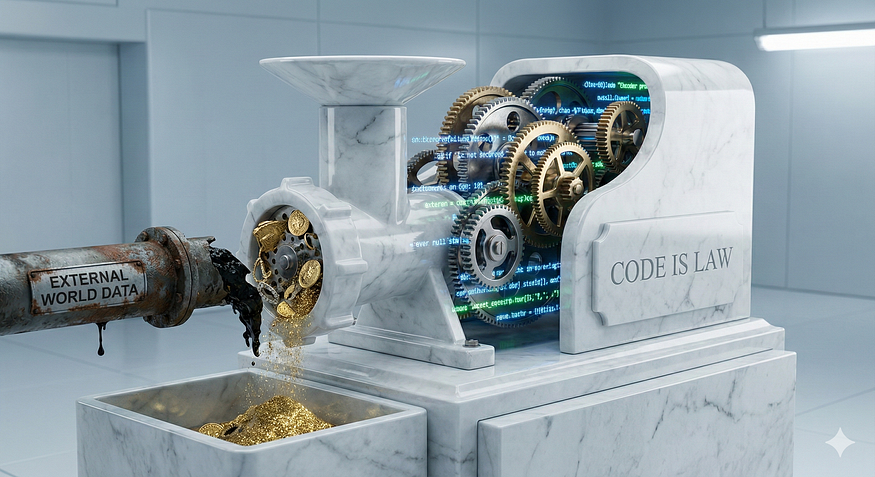
The criticisms above are the ones that serious analysts acknowledge when pressed. These two are the ones that almost nobody discusses publicly, because they cut closer to the foundational logic of blockchain itself — not failures layered on top, but tensions buried inside the core design.
これまで述べた批判は、真剣なアナリストなら追及されれば認めるものだ。しかしこれから述べる
2
つは、ほとんど誰も公に語らない。なぜならそれらはブロックチェーンの基礎ロジックそのものに触れるもので、後付けの失敗ではなく、設計の中心に埋め込まれた緊張だからだ。
The Oracle Problem
オラクル問題
Blockchain can only verify what exists on the blockchain. To interact with the real world (to execute a smart contract triggered by a commodity price, a weather event, an election result, a sports outcome) it needs to import external data through a service called an oracle.
ブロックチェーンは、ブロックチェーン上に存在するものしか検証できない。現実世界と連携するには、オラクルと呼ばれるサービスを通じて外部データを取り込む必要がある。
Oracles reintroduce exactly the trust problem that blockchain was built to eliminate.
オラクルは、ブロックチェーンが排除しようとした信頼の問題をそのまま再導入してしまう。
If the data coming in can be manipulated, the smart contract executing on that data will be manipulated. In 2022, Avraham Eisenberg borrowed $10 million, inflated the price of a token by 2,394 percent on a thin market, and used that manipulated price as the oracle input to drain $117 million from Mango Markets in loans the protocol’s code said he was entitled to. The oracle worked as designed. The source of truth was compromised. The Bank for International Settlements published a bulletin on precisely this problem, concluding that because importing real-world data into a blockchain always requires trusting a third party, “the future of DeFi in its purest sense looks bleak.” The oracle dependency cannot be engineered away. It is structural.
入力データが操作されれば、そのデータで動くスマートコントラクトも操作される。
2022
年、
Avraham Eisenberg
は薄い市場でトークン価格を
2,394%
吊り上げ、その操作された価格をオラクル入力として利用し、
Mango Markets
から
1
億
1,700
万ドルを引き抜いた。オラクルは設計通りに動いた。真実の源泉が破壊されていたのだ。
BIS
(国際決済銀行)は、純粋な意味での
DeFi
の未来は暗いと結論づけた。オラクル依存は技術的に取り除けない。構造的な問題だ。
Most smart contract applications depend on oracles. The trustlessness that blockchain provides ends precisely where it has to reach outside itself.
ほとんどのスマートコントラクトアプリケーションはオラクルに依存している。ブロックチェーンが提供する信頼不要性は、まさにブロックチェーンが外部と連携する必要があるところで限界を迎える。
“Code Is Law” Removes Human Judgment in Irreversible Ways
「コードが法」とは、人間の判断を不可逆的に排除する」
Traditional legal systems allow courts to intervene when a rule produces an outcome its drafters did not intend. Contracts can be voided for mutual mistake. Judges can apply equity when strict application of law produces injustice. This flexibility is not a weakness in the system — it compensates for the irreducible complexity of human life.
伝統的な法体系では、意図しない結果が生じた場合、裁判所が介入できる。契約は双方の錯誤によって無効となることがある。裁判官は、法律を厳格に適用すると不公平が生じる場合、衡平法を適用することができる。この柔軟性は弱点ではなく、人間社会の複雑さを補うものだ。
Smart contracts do not allow this. They execute. If the code allows something, it is allowed, regardless of whether anyone intended it, whether it is fair, or whether its consequences are catastrophic.
スマートコントラクトにはそれがない。実行されるだけだ。コードが許すなら、それは許される
──
意図や公平性、結果がどうであれ。
In April 2022, an attacker took out a flash loan ( a type of uncollateralized loan that must be borrowed and repaid within a single transaction block) of approximately $1 billion from Aave, a legitimate DeFi protocol. With it, he acquired 67 percent voting control in Beanstalk Farms’ governance system, passed a proposal transferring all funds to his own wallet, repaid the loan in the same transaction, and walked away with $80 million. The entire sequence happened inside a single block on the Ethereum blockchain. It took about 13 seconds. The blockchain executed perfectly. Every transaction was valid. No rule was technically broken. There was simply no human judgment in the loop to say: wait.
2022
年
4
月、攻撃者は正当な
DeFi
プロトコルである
Aave
から約
10
億ドルのフラッシュローン(単一のトランザクションブロック内で借り入れと返済をしなければならない無担保ローンの一種)を取得した。彼はそれを使って
Beanstalk Farms
のガバナンスシステムで
67%
の議決権を獲得し、すべての資金を自身のウォレットに送金する提案を可決し、同じトランザクションでローンを返済し、
8000
万ドルを持ち去った。この一連の出来事はイーサリアムブロックチェーン上の単一のブロック内で起こった。所要時間は約
13
秒だった。ブロックチェーンは完璧に実行された。すべてのトランザクションは有効だった。技術的にルール違反はなかった。単に、ループ内に「待て」と言う人間の判断がなかっただけなのだ。
The people who lost their money had no legal recourse, because the smart contract was the law. And the law did exactly what it was written to do.
損失を被った人々には法的救済がなかった。スマートコントラクトが法だったからだ。そして、その法律はまさにその通りに機能した。
These two failures — a trust dependency the architecture can’t eliminate, and a legal system that can’t forgive — don’t get discussed because they don’t have a villain. Nobody can be blamed. The design is working correctly. That is precisely the problem.
アーキテクチャでは排除できない信頼依存と、容赦のない法制度という、この二つの失敗は、悪者がいないために議論されない。誰も責めることができない。設計は正しく機能している。まさにそれが問題なのだ。
How to Hate It Correctly
正しく嫌う方法
I want to be precise about what this article does and does not argue.
この記事が主張していること、していないことを正確に述べたい。
It does not argue that blockchain is worthless. Part 1’s core case stands: most people who hate blockchain are actually hating cryptocurrency culture, and confusing the two is an error that prevents clear thinking.
ブロックチェーンが無価値だと言っているわけではない。パート
1
の主張は依然として有効だ。多くの人が嫌っているのはブロックチェーンではなく暗号資産文化であり、それを混同することが思考を曇らせる。」
It does not argue that these problems are unsolvable. Some of them may yield to engineering over time — better key recovery systems, stronger oracle designs, improved governance mechanisms.
これらの問題が解決不可能だと言っているわけでもない。時間が経てば、より良い鍵復旧システム、強力なオラクル設計、改善されたガバナンスなど、工学的に解決されるものもあるかもしれない。
What it argues is this: blockchain’s most serious problems are not imported from cryptocurrency speculation. They are native to the infrastructure. They are direct consequences of its most celebrated properties. And understanding them is the minimum standard for thinking clearly about the technology.
この記事が主張しているのはこうだ: ブロックチェーンの最も深刻な問題は、投機文化から持ち込まれたものではない。インフラそのものに内在している。それらは、ブロックチェーンが最も称賛されてきた特性の直接の帰結だ。そしてそれを理解することが、この技術について明晰に考えるための最低条件だ。
Immutability is why lost keys are permanent. Sovereignty is why most people hand their keys back to intermediaries. Decentralization is why new power cartels formed around staking and mining. Transparency is why governments love blockchain and built a surveillance industry around it.
不変性が、失われた鍵が永遠に戻らない理由だ。主権性が、多くの人が結局保護管理を仲介者に戻してしまう理由だ。分散化が、ステーキングやマイニングを中心に新たな権力カルテルを生んだ理由だ。透明性が、政府がブロックチェーンを好み、監視産業を構築した理由だ。
These are not contradictions between blockchain’s promises and its reality. They are the promises, fully realized, revealing their shadows.
これらは約束と現実の矛盾ではない。約束が完全に実現した結果、影が露わになっただけだ。
The honest position is not blockchain advocacy or blockchain dismissal. It is the position that a serious analyst holds about any powerful infrastructure: it does what it does, and the question is whether what it does serves the purpose you have in mind. That requires knowing both sides of the ledger.
誠実な立場とは、ブロックチェーン礼賛でも、ブロックチェーン否定でもない。それは、強力なインフラに対して真剣なアナリストが取る立場だ:それはそれとして動く。問題はその動作があなたの目的に合致するかどうかだ。」そのためには、台帳の両面を知る必要がある。
You can now hate blockchain for legitimate reasons. The next question is whether those reasons, weighed against what it can genuinely offer, settle the argument for you — or just make it more interesting.
あなたは今、正当な理由でブロックチェーンを嫌うことができる。次の問いは、それらの理由をブロックチェーンが本当に提供できるものと比較したとき、議論が決着するのか
──
それとも、より興味深くなるだけなのか、ということだ。
We’ll use Bitcoin as the case study next Sunday. Because Bitcoin’s entire 15-year history is an argument about exactly this: what it’s actually for, and whether what it does is what anyone intended.
来週の日曜日、ビットコインをケーススタディとして扱う。なぜならビットコインの
15
年の歴史そのものが、それは何のために存在するのかその動作は誰かが意図したものなのかという議論だからだ。
If Part 1 or Part 2 made something clearer — or raised a question you didn’t have before — follow OnchainJournals to catch Part 3 when it drops. That’s what we’re built for.
もし
Part 1
や
Part 2
が何かを明確にしたり、新しい疑問を生んだなら、
Part 3
が公開されるときに見逃さないよう
オンチェーンジャーナルズ
をフォローしてほしい。それが私たちの存在理由だ。
Cryptocurrency
暗号通貨
Money
貨幣
Technology
技術
Blockchain
ブロックチェーン
Education
教育
Written by Onchain Journals
オンチェーンジャーナル執筆
Deep dives on blockchain infrastructure, systems thinking, AI and onchain adoption. Independent writer, Educator/analyst. NOT AFFILIATED WITH ANY CRYPTO PROJECT
ブロックチェーンのインフラ、システム思考、
AI
、そしてオンチェーン採用についての深掘り。 いかなる暗号資産プロジェクトとも提携していない。
==============================
インターネット・コンピュータランキング
============================== ネットサービスランキング
==============================

-
先端技術情報20260916 2026.09.16
-
先端技術情報20260913 2026.09.13
-
先端技術情報20260830 2026.08.30


