


2021年10月05日

テーマ: 今日のワイン(6238)
カテゴリ: PCネット時計カメラ
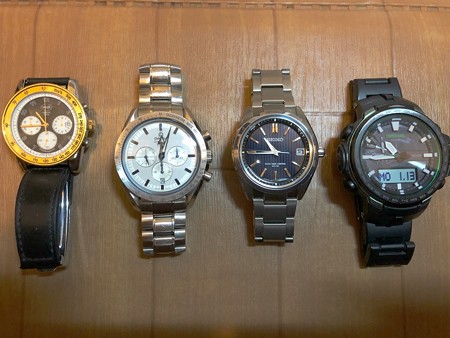
I often go to the mountains and need it for exams, so in recent years I’ve mostly been using radio-controlled watches. However, the flagship watch in my collection at home is the Omega Speedmaster Broad Arrow 1957, which is the second from the left in the photo.

この時計、2013年に中古で購入したのですが、安かった理由が、「サファイアグラスの表面のコーティングに剥がれがあるから」でした。
(※剥がれがうまく撮影できず、写真でお見せできないのが残念です。)
都内のショップのHPで見つけて、わざわざ実物を見に行きました。確かにサファイアガラスの三分の一ぐらいのエリアに剥がれがあって、角度によってかなり煩わしく感じるものの、それは特定の角度で見る時で、ふだんはそう気にならないので、まあいいかと思って購入したのでした。
購入後、長く使っていれば、ガラスに傷をつけないとも限らないし、その時にまとめて交換すればいいかな、という思いもありました。
それから8年。ベルトを修理したり、オーバーホールもすませたりとメンテナンスは欠かしていませんが、コーティングの剥がれがだんだん大きくなってきているようで、ひどく気になるようになりました。
オーバーホールの際、サファイアガラスを交換したらいくらかかるか聞いたところ、なんと13万円!とのこと。
交換はあきらめて、その後この話題は棚上げになっていたのですが、最近、電波時計に押されて使用頻度が下がっていることもあり、あらためてこのタイミングでコーティングを剥がしてしまおうと思い立ちました。
https://www.chronoagent.com/faq/faq_omega.htm
マーク40の無反射コーティングの修復について
https://www.webchronos.net/features/24931/
風防のコーティング、メリットとデメリットは何?
http://tamtime.net/consul/2013/04/008232.html
無反射コーティング剥がしについて
今回、コーティング剥がしをお願いしたのは、前回マハラのOHをしてもらったTamtimeさん。
https://tamtime.net/
コーティングが頑強で、研磨だけではなかなか剥がれず、ガラス専門工場に依頼して薬剤で剥がしたとのこと。最初2週間と言われていた納期が結局1ヶ月以上かかりましたが、届いた現物をみると、綺麗になっていて満足です。費用は8Kほどでした。

綺麗な化粧箱に入って戻ってきました。

パッと見た感じではコーティングを剥がしたとは判りませんね。
(Unfortunately, I wasn’t able to capture the peeling well enough to show it in photos.)
I found it on a Tokyo shop’s website and went to see the actual watch in person. Indeed, about one-third of the sapphire glass area had peeling, and depending on the angle, it was quite annoying. However, since it was only bothersome at certain angles and didn’t usually bother me, I decided it was acceptable and went ahead with the purchase.
After buying it, I thought that since it might get scratched after long use, I could just replace the glass altogether at that time.
Eight years have passed since then. I’ve maintained the watch with strap repairs and overhauls, but the peeling on the coating seems to have grown, and it’s become increasingly bothersome.
When I asked how much it would cost to replace the sapphire glass during the last overhaul, the answer was a staggering 130,000 yen!
It’s common on the internet to see articles mentioning that anti-reflective coatings on Omega and Breitling crystals can peel off. Omega watches have coating on both sides of the glass, but it’s not always necessary. In fact, brands like Rolex don’t apply coatings at all (though recently some models have started to).
Omega Mark 40 anti-reflective coating restoration
Pros and cons of crystal coatings
About removing anti-reflective coatings
This time, I asked Tamtime, who did the overhaul on my Mahara watch, to remove the coating.
https://tamtime.net/
The coating was very tough and couldn’t be removed by polishing alone, so they sent it to a glass specialist factory where the coating was removed chemically.
Though they originally said it would take two weeks, it ended up taking over a month. But when the watch arrived, it looked clean and I’m satisfied. The cost was about 8,000 yen.
It came back in a beautiful presentation box.
At first glance, you wouldn’t notice that the coating had been removed.
***************
…と書いたのですが、2~3日使用してみると、思いのほかコーティングを剥がす前と比べて、印章が異なることに気づきました。まず、室内では蛍光灯などが反射して想像していた以上に針が見ずらいです。それに加えて、光の透過率が下がったことによるのか、文字盤そのものが、白の鮮やかさが減ってぼんやりした感じになってしまいました。全体的にクリーム色っぽく見えるんですよね。そうなってくると不思議なもので、時計の文字盤全体の輪郭もぼんやりとした風に感じます。
…That’s what I wrote initially, but after using the watch for two or three days, I noticed some unexpected differences compared to before the coating was removed.
First, indoors under fluorescent lighting and such, the hands are more difficult to see than I had imagined due to increased reflections.
Additionally, perhaps because the light transmission has decreased, the dial itself seems less vibrant—the white looks duller and somewhat muted. Overall, it appears more cream-colored.
Strangely enough, once this happens, even the entire outline of the dial looks somewhat blurred or softened.

この写真はコーティングを剥がす前ですが、斜めから見たときにこのようなクリアさがなくなってしまった感じです。
This photo was taken before the coating was removed, and the clear sharpness you see here from an angle has now disappeared.

思うに、ガラスの側面の部分の乱反射が、印象が変わった大きな原因ではなかろうかと。
Tamtimeさんはよい仕事をしてくれたので、文句は全くないのですが、時計の印象が予想以上に変わってしまったのが残念です。逆に言えば、それだけ無反射コーティングの効能が大きかったということなんでしょうね
I think a major reason for the changed impression is the increased glare caused by light reflecting off the edges of the glass.
Tamtime did a great job, so I have no complaints at all. It’s just a bit disappointing that the watch’s overall look changed more than I expected. On the other hand, that probably just shows how effective the anti-reflective coating was.
さらに追記:しばらく使っていたら、コーティングのない状態にもすっかり慣れました。もとからこういうものだと思えば何の不満もありません。何より見た目の見苦しさがなくなったので、結果的に剥がしてもらってよかったと思います。
Additional note: After using it for a while, I’ve completely gotten used to the uncoated glass. Once you accept it as normal, there’s really no issue. Above all, the watch looks cleaner without the coating, so in the end, I’m glad I had it removed.
受難の時計たち~その1(マハラ・クロノグラフ)
受難の時計たち〜その2(ポルシェデザイン・ムーンフェイズクロノ)
受難の時計たち〜その3(ホンダF-1クロノグラフ)
受難の時計たち~その4(オメガ・スピードマスター・デイト)
受難の時計たち~その5(IWCポートフィノ)
新しい相棒(オメガ・スピードマスター・ブロードアロー)
クォーツ時計のオーバーホール(マハラ・クロノグラフ)
【時計】オメガの修理とマハラのオーバーホール
梅雨の合間に高尾山「上級者コース」~カシオ・プロトレックの検証を兼ねて
腕時計を買った(セイコー・ブライツ)
オメガ・スピードマスター・ブロードアローの無反射コーティングを剥がしてみた
マハラ・ギョウシェのオーバーホール~その1
マハラ・ギョウシェのオーバーホール〜その2
マハラ・ギョウシェのオーバーホール〜その3
お気に入りの記事を「いいね!」で応援しよう

[PCネット時計カメラ] カテゴリの最新記事
-
オメガ・スピードマスター・ブロードアロ… 2026年04月14日
-
自宅のネット環境改善(その2)~メッシ… 2026年04月08日
-
自宅のネット環境改善(その3)~メッシュ… 2026年04月08日


【毎日開催】
15記事にいいね!で1ポイント


PR
Comments
shuz1127
@ Re[1]:モーリス・ユトリロ展@SOMPO美術館~その1 Maurice Utrillo Exhibition at the SOMPO Museum — Part 1(11/10)
Henryさん おお、西山美術館に行かれたの…
Henry@ Re:モーリス・ユトリロ展@SOMPO美術館~その1 Maurice Utrillo Exhibition at the SOMPO Museum — Part 1(11/10)
西山美術館、メルカリで無料招待券をお安…
shuz1127
@ Re[1]:ほどよく均整の取れたベリーA~マスカットベリーA2023(白百合醸造) Well-Balanced Berry A – Muscat Bailey A 2023 (Shirayuri Winery)(10/10)
noir-funさんへ 熊本ワインファーム、例…
noir-fun
@ Re:ほどよく均整の取れたベリーA~マスカットベリーA2023(白百合醸造) Well-Balanced Berry A – Muscat Bailey A 2023 (Shirayuri Winery)(10/10)
機会があれば是非、熊本ワインファームの…
shuz@ Re[1]:悪くはないのだけど…エラスリス MAX・カベルネソーヴィニヨン2020 “Not bad, but not quite…” — Errazuriz MAX Cabernet Sauvignon 2020(09/24)
noir-funさん ご無沙汰していますが、お…
Category
カテゴリ未分類
(11)お知らせ・リンク集
(29)ワイン新着情報
(540)ワインコラム
(344)ワインコラム2(話飲徒然草拾遺集)
(75)ワインコラム3(RWGコラム拾遺集)
(28)都内近郊散策
(300)こんな店に行った
(346)B級グルメ・カフェ
(248)健康
(225)エッセイ
(80)ひとりごと・備忘録
(552)カミサン推薦ネタ
(28)語学・資格・学び直し
(97)山歩き・ハイキング
(124)アクアリウム・ガーデニング
(340)育児・教育
(88)PCネット時計カメラ
(140)音楽・オーディオ
(75)リフォーム引越し
(50)こんなワイン買った
(131)ボルドー
(102)ブルゴーニュ・ジュブレシャンベルタン
(90)ブルゴーニュ・モレサンドニ
(40)ブルゴーニュ・シャンボールミュジニー
(45)ブルゴーニュ・ヴォーヌロマネ・ヴジョ
(56)ブルゴーニュ・NSG
(58)ブルゴーニュ・その他コートドニュイ
(64)ブルゴーニュ・コルトン・ポマール・ヴォルネイ
(30)ブルゴーニュ・ボーヌ周辺
(56)ブル・ピュリニー・シャサーニュ・ムルソー
(21)ブルゴーニュ・その他コートドボーヌ
(27)ブルゴーニュ・裾モノイッキ飲み!
(221)ブルゴーニュ・その他地域
(37)ボジョレー再発見プロジェクト
(32)シャンパーニュ
(195)ロワール・アルザス・ローヌ
(55)その他フランス
(17)イタリア
(83)スペイン・ポルトガル
(38)ニュージーランド・オーストラリア
(49)USA
(42)安泡道場(シャンパーニュ以外)
(37)その他地域・甘口など
(44)日本ワイン
(71)ワイン会・有料試飲
(173) 213系ラストラン
New!
musigny0209さん
【山形・福島旅行】… New!
ささだあきらさん
New!
ささだあきらさん
ルイ・ジュリアン …
New!
mache2007さん
月一会 卯月
ミユウミリウさん
ジャッキー・トルシ…
hirozeauxさん
サンジュストアレン…
yonemuさん
エクシブ浜名湖へ
zzz.santaさん
ワイン&ジョギング … Char@diaryさん
道草日記 旅・釣… 道草.さん
鴨がワインしょって… うまいーちさん
【山形・福島旅行】…
New!
ささだあきらさんルイ・ジュリアン …
New!
mache2007さん月一会 卯月
ミユウミリウさんジャッキー・トルシ…
hirozeauxさんサンジュストアレン…
yonemuさんエクシブ浜名湖へ
zzz.santaさんワイン&ジョギング … Char@diaryさん
道草日記 旅・釣… 道草.さん
鴨がワインしょって… うまいーちさん
Keyword Search
▼キーワード検索
Calendar
© Rakuten Group, Inc.
