Entries from June 1, 2011 - June 30, 2011

Friday
Jun 24 2011

Summer Tutoring - Think About It

See You Before September


Former Secretary of Defense Robert MacNamara noted, "If it can't be counted, it doesn't count." Here at Think Tutoring, we have the measurements, the "counts," that validate the approaches we are taking to improve basic skills. Ever since 2009, for example, students who completed our reading program averaged 1.7 grade level-improvement in Vocabulary, and 1.8 grade level-improvement in Comprehension....in just three months.

The results for math are even better. In the same timeframe, students completing our program averaged 1.9 grade level-improvement in Computation and 2.0 grade level-improvement in Concepts and Applications.

Although the  school year will soon end, it's never too early to think about the new school year.

Get Ready for Back-To-School

If your child's end-of-year results in math and reading are below grade level, summer tutoring could make him grade-level prepared by September. We have several programs at Think Tutoring, designed to diagnose his weaknesses and overcome them. If your child is already at grade level, summer studies could prevent the famous "summer slide" and make him super-ready to start the new school year.

Additionally, as September gets closer,talk to your child about school. Acknowledge that all beginnings are hard. Share with your children some of the difficult beginnings you yourself have had to face. And offer examples to show that most obstacles are surmountable.

Know the School.

If your child is starting a new school in September, not just a new grade, do all you can to familiarize her with the school. Even if she takes the school bus, go on several rides to help her get a sense of where the school is. If she will be walking, walk with her several times. Discuss the building and the campus on your visits.

If possible, schedule a late-August meeting with the principal and one or two of her teachers. Learn in advance what books your child will be reading during the next school year and do a little homework about the authors of those books. Find out what extra-curricular activities will be available to students her age and discuss what she might like to participate in.

Further, study the school's home page if they have a web site. If the school represents a major shift--elementary to middle school, for example, or junior high to high school--go online to learn general information about these school divisions.

Build a Support System.

Find out which neighborhood children will be attending the same school. Introduce them to your child--perhaps set up some play dates. Arrange car pool plans with other parents. Volunteer, if you can, to coach a team your child might be joining.

Get Your Passport Ready.

 "Education is the passport to the future, for tomorrow belongs to those who prepare for it today." Think Tutoring was founded to make your child's future brighter through education. Prepare today for that future.
Tuesday
Jun 21 2011

How to Improve SAT Scores: Critical Thinking

Connections-Thinking: It's Critical

It's been said that one measure of intelligence is the ability to discern patterns among seemingly unrelated bits of information. The secret lies in that word "seemingly." In truth, there are numerous connections to be made within a given word or fact or observation. Consider the words of naturalist John Muir, "When we try to pick out anything by itself, we find it hitched to everything else in the universe. "

HELP YOUR CHILD "HITCH"

At his informative website ( www.criticalreading.com ), author Dan Kurland describes what is happening when people think critically. Among other things, he notes, critical thinkers evaluate all reasonable possibilities surrounding the solution to a problem.

Kurland's not the only one to endorse a wide-net inclusion of alternatives. Journalist H.L. Mencken also noted that "for every complex problem, there is one solution that is simple, neat....and wrong!" Students will often "jump" at the first answer that seems right and then feel defeated when told that answer is not correct. Those willing to tolerate chaos for a while longer and to consider non-obvious ramifications of the situation can hone their critical thinking skills and prepare themselves for future, more-complex problems.

PATTERNS ON THE GO

IQ tests are filled with questions related to a learner's ability to find patterns-- some visual, some verbal, some mathematical. As your child gets closer and closer to college and even graduate school admission, he will continue to get

pattern-questions on various tests.  (More about that below)

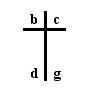
To illustrate: What letter clearly, visibly, proportionately, obviously does not belong in the diagram below?

Try this with your family. You will no doubt get some "good" answers. For example, the "c," because all the other letters are closed letters. Or, the "b," because--if letters could be said to be facing a certain way--they are all looking to the right, but the "b" is looking to the left. Or the "g," because it is out of order. (In the alphabet, it comes after, not before the letter "d.") Or even the "g," because it is the only letter that lies partially beneath the line. Or the "c," because it is the only "open" letter.  Yes, all of these are good answers. But the only letter that is truly visibly and proportionately out of place is the letter "t."

Whenever you can, explore multiple possibilities to given situations. Develop critical thinking via connections-thinking such as answers to this question: "What if elephants could fly?" (Consider airports, big and study umbrellas, air traffic control, and so on.) Ask one such question a week of your family. Have an outside judge select his or her favorite and award a token prize to the "If-er of the Week."

Critical reason skills are vital for students wishing to well on the SAT examination, a test that at its core, is a reasoning test.  At Think Tutoring, our SAT Prep program prepares students to succeed by not only mastering the fundamental skills of math, reading and writing, but recognizing patterns and applying deductive reasoning.   Because the first and most obvious answer is not always the correct one.

For more information on our SAT Prep Program , call as 973-593-0050, or visit us at www.thinktutoring.com.

Tuesday
Jun 07 2011

Motivating the Un-Motivated Child, The Think Tutoring Way

One of the most difficult challenges both parents and teachers face is motivating students who are not intrinsically motivated to learn. How can we make students want to succeed academically? Should we exhort them? Punish them? Entertain them? Perhaps; there are proponents and critics for each of those strategies.

The experts agree, however, that the most successful techniques teachers and parents can use to motivate students include engaging their interest, displaying enthusiasm for what they are teaching, and establishing challenging, but achievable expectations.  At Think Tutoring, we employ various motivational stratagies.  Most importantly, we provide regular positive reinforcement for kids who put forth their best effort.  We continually let them know that their hard work willl pay off, and we do so without heaping false praise.

On a lighter  but no less important note,  each student also earns  " Think Tutoring Points" for demonstrable effort and work well done.  Students save their points in a pencil pouch and can exchange them for fun prizes -- toys, games and gift cards of varying value levels.

Finally, we also have "Success Time", where kids can relax after each instructional hour by playing nerf basketball, jumping rope or board games such as the Think Tutoring favorite, Blokus.  This "down time" gives kids a little breathing room and helps our environment remain devoid of stress.  At Think Tutoring, we believe that learning environments should both serious and fun.

This form does not yet contain any fields.

    Enter your email address:

    View Site in Mobile | Classic
    Share by: