2018年09月の記事
全17件 (17件中 1-17件目)
1
-
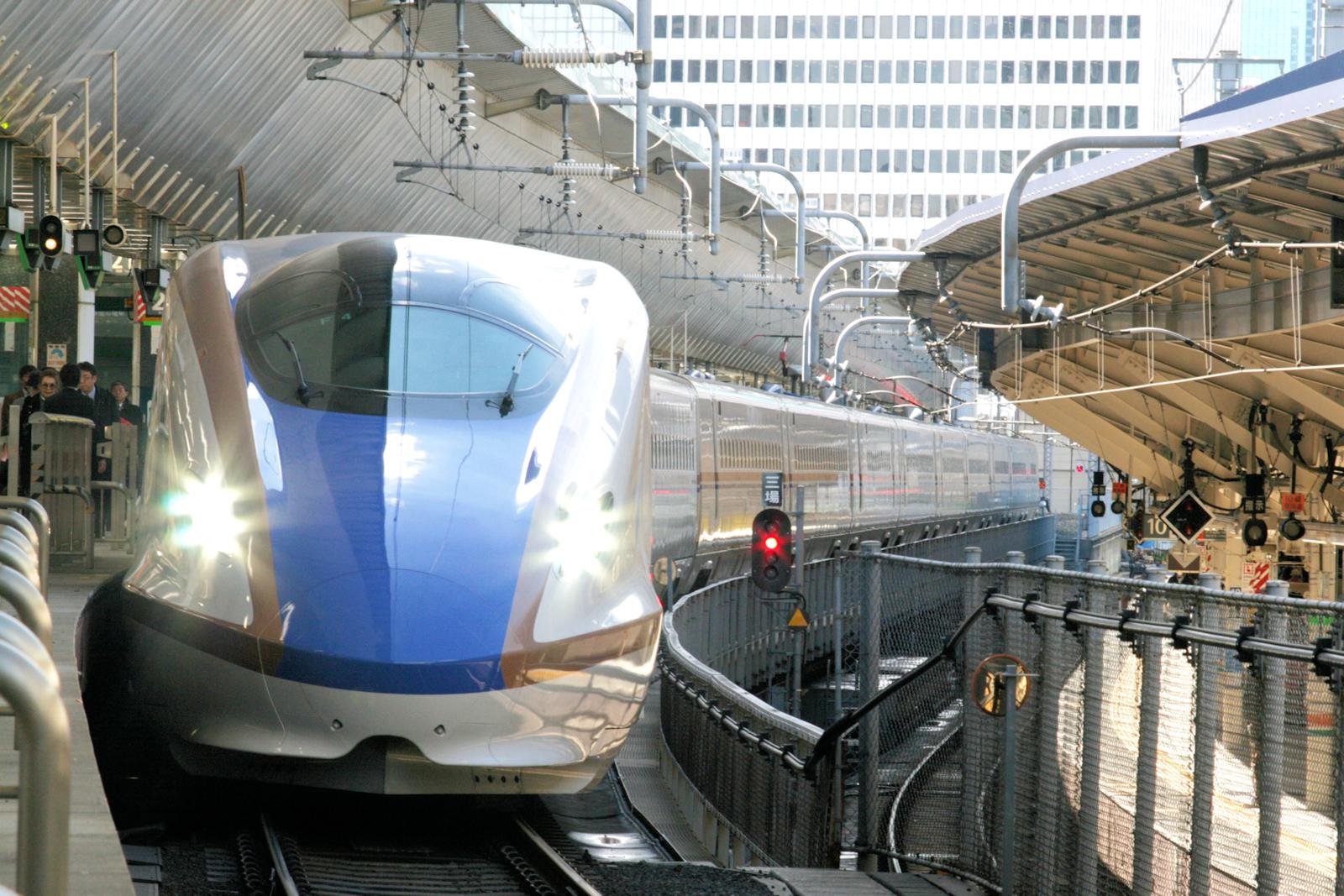
立山・黒部アルペンルートと富山県の鉄道を巡る旅 北陸新幹線「かがやき」初乗車
いよいよ4日間旅した富山県ともお別れの時が来てしまった。最後に乗る列車は、JR西日本・JR東日本北陸新幹線の「かがやき」である。これに乗って東京駅へと戻る。北陸新幹線の列車という点でも、E7系新幹線電車という点でも、僕にとっては初めての乗車である。車両は長野新幹線車両センター(長ナシ)所属のF2編成。今回は普通車に乗車した。E7系普通車の座席は「彩りの和」をコンセプトにデザインされた。格子柄をあしらい、色彩豊かで明るく楽しさの感じられる空間を創り出している。初めての北陸新幹線の旅は、夕方から夜にかけての乗車だったため、窓から景色を見てもほとんど何も判らなかったのが残念だったが、富山駅~東京駅間の2時間強は快適な時間を過ごせた。E7系の普通車の振動軽減装置はセミアクティブサスペンションであるが、以前に乗車した近鉄50000系電車と同様のフルアクティブサスペンションと勘違いするくらい走行中の揺れを感じなかった。「かがやき」の最高速度は260km/hと、近年の新幹線としては決して速い方ではないが、北陸新幹線開業前は在来線特急列車「はくたか」と上越新幹線「とき」とを乗り継いで3~4時間かかっていた富山駅~東京駅間が、「かがやき」では2時間強の乗車時間で、しかも乗り換えなしでたどり着けるようになったことは、北陸地方と東京との間がより行き来しやすくなったのだと、実際に乗車して改めて感じた。The time to ride the last train during this travel had come. It was Hokuriku Shinkansen "Kagayaki" super express to Tokyo.It was first time for me to travel both on Hokuriku Shinkansen and with E7 Series Shinkansen. The train I rode was F2 set belonging to Nagano Shinkansen Rail Yard and my seating was a regular-class.The colours of its seatings are designed under the concept of classical-Japanese image with lattice pattern to create a bright atmosphere. Because of on the evening and night, I couldn't see the scenery from the window. However, I could enjoy the travelling. Though the regular-class carriages of E7 Series equip passive shock absorber, not the bogies with anti-vibration pneumatic actuator (active suspensions), I felt few vibration as the carriage does the latter like Kintetsu 50000 Series "Shimakaze".Though the maximum speed of "Kagayaki" is 260-kilometre/161.56-mile per hour, It takes little more than 2 hours between Toyama Station and Tokyo Station; shortening the travel time about 2 hours before the Shinkansen's extension in 2015 via Joetsu Shinkansen and limited express train, which means that it became easier to travel between the two stations while travelling.10-1264 E7系北陸新幹線「かがやき」 基本セット(3両)(再販)[KATO]《取り寄せ※暫定》楽天で購入
Sep 20, 2018
コメント(0)
-
立山・黒部アルペンルートと富山県の鉄道を巡る旅 IRいしかわ鉄道521系に初乗車
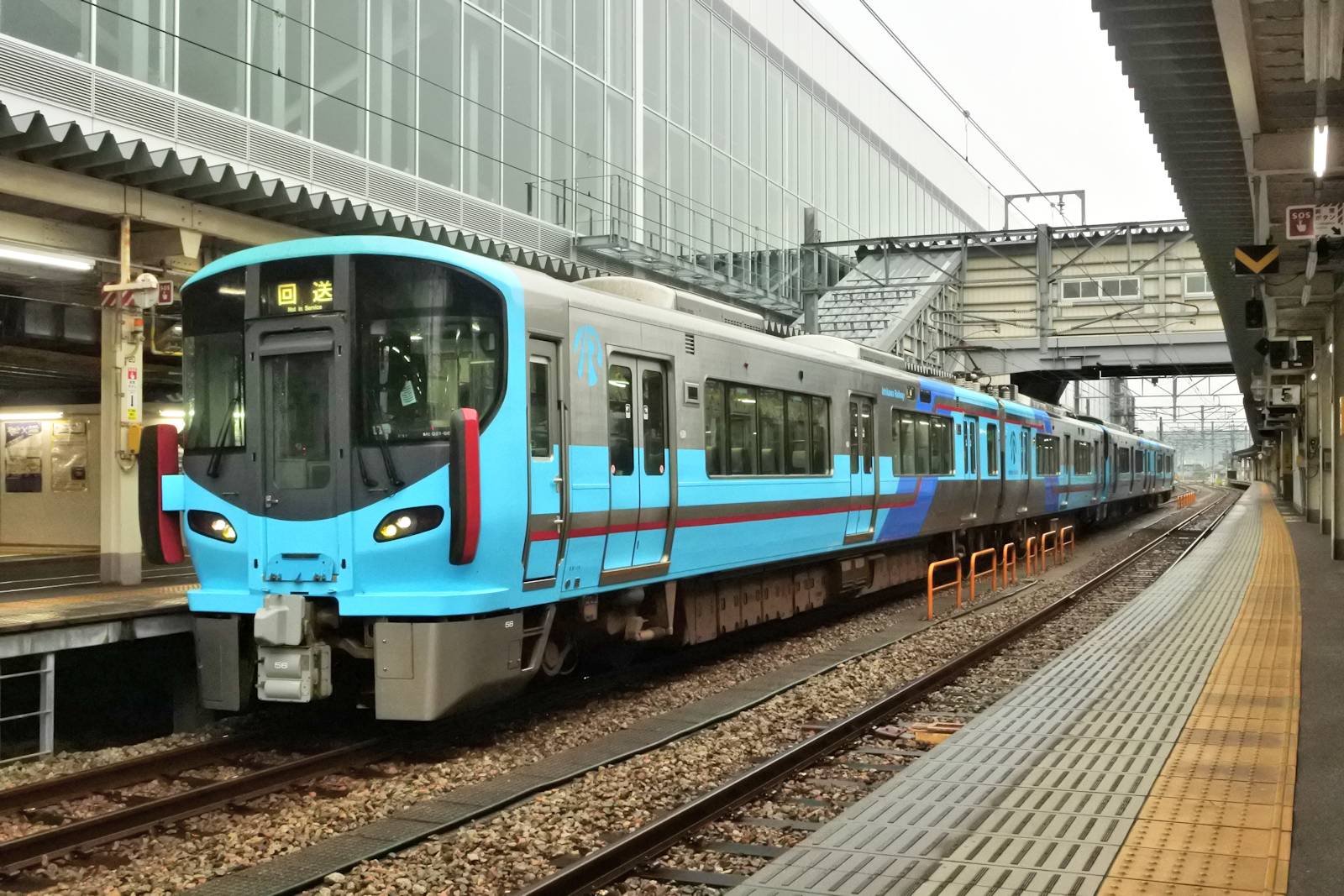
万葉線の旅を終えて、高岡駅へと戻ってきた。高岡駅から富山駅まではあいの風とやま鉄道線に乗車。僕が乗った列車は、IRいしかわ鉄道521系電車による各停富山行きだった。IRいしかわ鉄道は、あいの風とやま鉄道と同様に、JR西日本北陸新幹線の開業と同時に、同社から北陸本線の一部区間を引き継いだ鉄道事業者の1つ。石川県内の金沢駅~倶利伽羅駅間を引き継ぎ、IRいしかわ鉄道線として運行している。同線の列車は金沢駅~富山駅間であいの風とやま鉄道線と相互乗り入れを行っている。僕が乗った521系は、“225系顔”タイプの56編成(元ツルJ21編成)であった。この編成はJR西日本が発注し、IRいしかわ鉄道へ譲渡されたものであるが、初めから譲渡することを前提に、路線が譲渡される直前の2015(平成27)年2月に落成した。JR西日本の車両として一旦入籍しているものの、JR西日本時代は一度も営業運転に就くことなく、IRいしかわ鉄道へ譲渡された。富山駅では地上に位置する4番のりばに到着した。あいの風とやま鉄道線の魚津・泊・糸魚川方面行き列車が到着するホームも2019(平成31)年3月に高架化されることが予定されており、このホームに停車する姿が見られるのは、残りわずかの期間である。Coming back to Takaoka Station from Manyosen Tramway, I travelled with a local train on Ainokaze Toyama Railway Line operated by IR Ishikawa Railway 521 Series to Toyama Station.IR Ishikawa Railway is a railway company inheriting a part of Hokuriku Main Line in Ishikawa Prefecture from JR West when Hokuriku Shinkansen being extended from Nagano Station to Kanazawa Station in 2015 like Ainokaze Toyama Railway. It took over the section between Kanazawa Station and Kurikara Station, and the trains go through Ainokaze Toyama Railway between Kanazawa Station and Toyama Station.The carriage I got on was 56 set (former Tsuru J21 set), whose front design resembling that of 225 Series. The set had been manufactured by JR West in 2015, but under assumption of ownership exchange to IR Ishikawa Railway and it hadn't been in service when belonging to JR West.At Toyama Station, the train stopped at platform 4 for the trains on Ainokaze Toyama Railway Line going toward Uozu, Tomari, and Itoigawa. The track is planned to be elevated on March, 2019. The scene in the photograph can't be seen within about three months.
Sep 20, 2018
コメント(0)
-
立山・黒部アルペンルートと富山県の鉄道を巡る旅 万葉線「ドラえもんトラム」に乗る
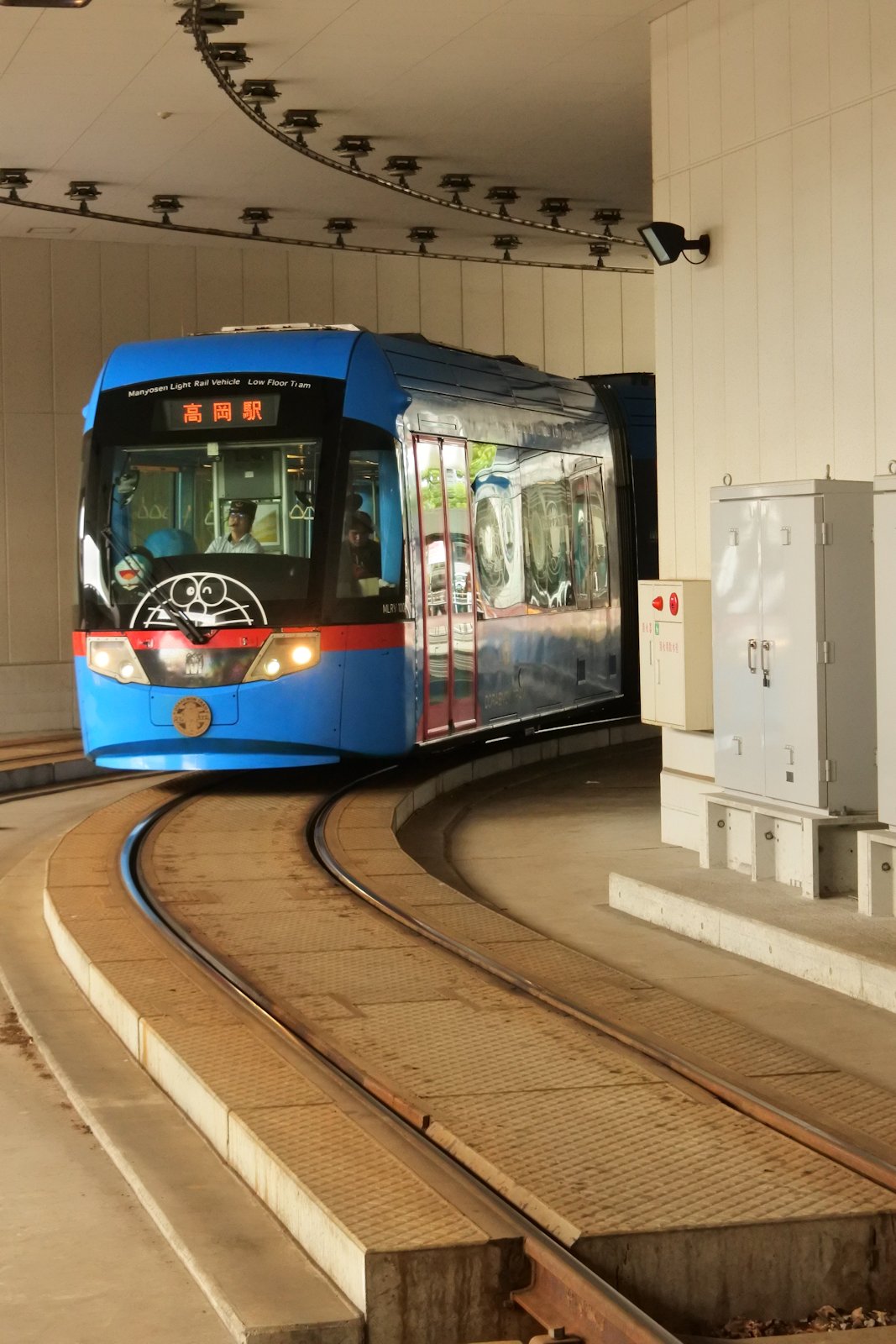
高岡駅からは万葉線に乗る。万葉線は高岡駅電停~六渡寺電停間の高岡軌道線と六渡寺電停~越ノ潟電停間の新湊港線の2つの路線から成るが、両線は一体化しており、合わせて「万葉線」と呼ばれている。また法令上、高岡軌道線は軌道法適用の路面電車、新湊港線は鉄道事業法適用の普通鉄道であるが、車両は路面電車タイプのもので運行されている。僕が万葉線に乗るのは2009(平成29)年以来9年ぶりのことであるが、2014(平成26)年に高岡駅電停が移設されてからは今回が初めてである。今回の万葉線に来た理由は「ドラえもんトラム」への乗車である。「ドラえもんトラム」は、「ドラえもん」の作者である漫画家、藤子・F・不二雄先生が高岡市出身であることにちなみ、漫画の中でドラえもんが誕生する100年前と設定されている2012(平成24)年から、MLRV1000形電車1編成(MLRV1004号車)をドラえもんの体の色である青色を基調に、首輪の色である赤色の帯を巻き、さらには側扉はひみつ道具の1つ、「どこでもドア」が描かれたラッピングを施したもの。側窓にもドラえもんと仲間たちのイラストが描かれている。車内へと足を踏み入れると、内装も青色を基調としたもの(通常のMLRV1000形は白色を基調としたもの)であり、天井には頭にタケコプターを付けて空を飛ぶドラえもんと仲間たちが描かれている。運転席の後ろにはドラえもんのぬいぐるみも出迎えてくれる。僕はドラえもん達に囲まれながら、終点の越ノ潟電停まで乗った。このドラえもんトラムは、内外装は徹底してドラえもん一色であったが、1つだけ残念だった点は、先ほど乗ったJR西日本氷見線を走る「忍者ハットリくん」ラッピングのキハ40系とは違い、車内アナウンスが通常のものしか流れないことである。前回僕が万葉線に乗った時には、射水市出身の落語家・立川志の輔さんの声による観光客向けのアナウンスを流していた。この実績もあることから、これと同様にドラえもんトラムでは、ドラえもん(水田わさびさん)の声によるアナウンスを流せば、より魅力的な車両になるのではないかと言いたい。From Takaoka Station, my travel by Manyosen tram connecting between Takaoka City and Imizu City started.Though Manyosen tramway officially consists of Takaoka Inner City Line, between Takaoka Station Stop defined based on Tramways Act, and Rokudouji Stop and Shin-minato Port Line, between Rokudouji Stop and Koshinokata Stop based on Railway Business Act, the two lines functions as one route and tramcars are in service on the two lines.My last travel on Manyosen had been in 2009, but it was first time for me after Takaoka Station had been relocated.This time the tramcar which I would like to travel with the best was MLRV1000 Series MLRV1004 set, whose body and interior have the livery with the colour of and characters from "Doraemon" comics, which is drawn by a Japanese comic artist born in Takaoka City, Fujiko F Fujio. MLRV1004 set keeps being in service with the livery since 2012, 100 year before the year of production of Doraemon in the comic. The body livery is coloured blue, the body colour of Doraemon, with a red line, that of Doraemon's collar, and its passengers' doors are coloured pink looking like one of the gadgets from Doraemon's pocket "Anywhere Door". On its windows, the illustrations of Doraemon and his friends are attouched.Getting onto the tram, the interior is also based on blue, the colour of Doraemon's body and the sky and decorated with the characters; the characters flying with The Hopter on its roof are pictured and a Doraemon plush doll is put behind the driver's cab.I travelled to Koshinokata terminal.I would like to say that its exterior and interior design is full of Doraemon world, but it was only one disappointed thing for me that the announcement by Doraemon's voice (voiced by Wasabi Mizuta) isn't introduced unlike Kiha 40 Series on JR West Himi Line having "Ninja Hattori-kun" body livery. Introducing the announcement by Doraemon may be better to attract more passengers.越ノ潟電停から高岡駅電停へと折り返すMLRV1000形1004-A・B号車 新湊大橋を背景に MLRV1000 Series MLRV1004 set at Koshinokata Stop against Shin-minato Ohashi BridgeプラレールSC-06ドラえもんトラム楽天で購入
Sep 20, 2018
コメント(0)
-
立山・黒部アルペンルートと富山県の鉄道を巡る旅 氷見線初乗車
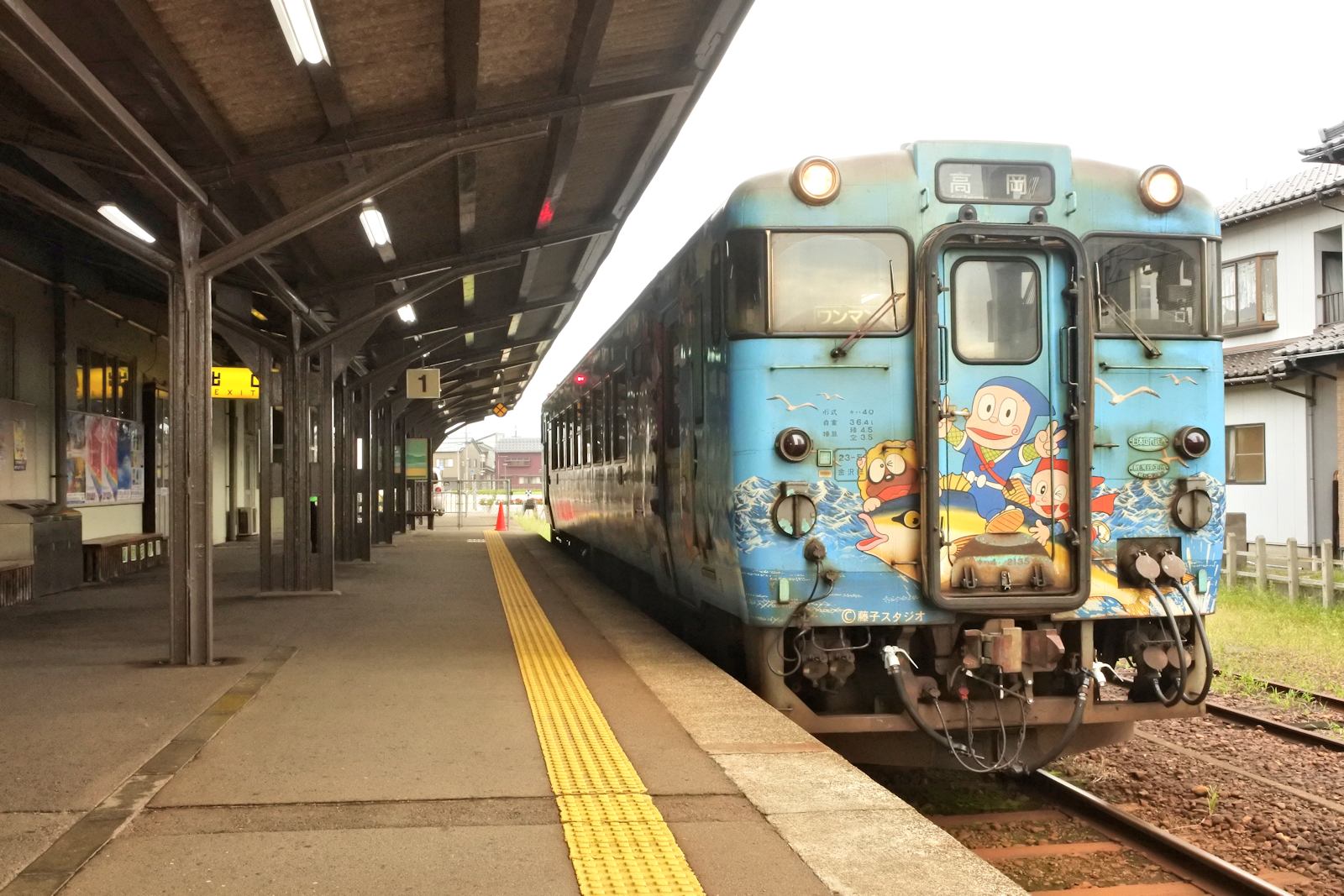
富山県の旅もいよいよ最終日を迎えた。この日最初に乗る路線は、JR西日本氷見線。氷見駅から高岡駅へと向かう。氷見線を走る北陸広域鉄道部所属のキハ40系の一部には、氷見市出身の漫画家、藤子不二雄A先生の代表作の一つである「忍者ハットリくん」のキャラクターたちが車体や車内を彩っている。今回乗車したキハ40-2135も、このうちの1両である。氷見駅から2駅目の雨晴駅で下車し、富山湾と義経岩を背景に走る列車の写真を撮る。雨晴駅~越中国分駅間は富山湾沿いを走る、氷見線随一の絶景を愛でられる区間として知られている。撮影場所は義経岩踏切の向かいに建つ、2018(平成30)年4月25日に開業した新しい撮影スポット、「道の駅 雨晴」の3階テラス。15分ほど待ち、氷見行きの列車がやって来た。この車両も「忍者ハットリくん」のキャラクターたちが車体に描かれた車両のうちの1両(キハ40-2090)だった。雨晴駅へと戻り、高岡行きの列車に乗る。先ほど撮影したキハ40-2090が氷見駅から折り返して来た。この列車では「忍者ハットリくん」の主人公、ハットリくん(担当声優は堀絢子さん)の声による観光案内アナウンスが、通常のアナウンスと共に再生された。先ほど道の駅 雨晴のテラスから見た富山湾を今度は車内から見る。雨晴駅から越中国分駅に向かって順に、富山湾に浮かんでいる三ツ岩、女岩、平床岩、男岩が進行方向左側に見えた。越中国分駅の手前で、富山湾沿いを走る区間は終わる。この先の伏木駅~能町駅間は工場が立ち並ぶ区間。ここで富山県七大河川の1つである小矢部川を渡り、万葉線高岡軌道線をアンダークロスする。能町駅の手前ではJR貨物新湊線が合流する。次の越中中川駅を発車してしばらく走ると、進行方向右側の車窓に高岡市立定塚小学校が見える。ハットリくんの車内アナウンスでも紹介されているが、ここは藤子不二雄A先生と藤子・F・不二雄先生とが出会った学校なのだという。線路が進行方向右にカーブを描くとあいの風とやま鉄道線の線路と並走する。終点の高岡駅はもうすぐだ。列車は7番のりばに到着した。氷見線は今回が初めての乗車だったが、雨晴駅~越中国分駅間の富山湾の絶景を以前から見たかったことから、一度乗車してみたかった。ハットリくんの声による車内アナウンスも聴けてよかった。そして、道の駅 雨晴の展望テラスは新しい撮影スポットの発見だった。On September 20th, the last day of travelling in Toyama Prefecture, I first travelled on JR West Himi Line between Himi Station and Takaoka Station.Himi Line trains are served by Kiha 40 Series diesel train, belonging to Toyama Railyard and some of them having body liveries and interior decorations of "Ninja Hattori-kun" by Fujiko Fujio A, one of the most famous Japanese comic artist and born in Himi City. The one I rode on, Kiha 40-2135, had the livery.I got off the train once at Amaharashi Station, the two stations after Himi, to photograph a train running along Amaharashi Coast against the Toyama Bay and Yoshitsune-iwa Rock. Where I photographed was the terrace of "Michi no Eki Amaharashi", a multi-function building as a souvenir store, cafe, and information counter for tourists, opened at April 25th, 2018.15 minutes later, the train came from Takaoka Station. It was the other one having "Ninja Hattori-kun" body livery, Kiha 40-2090.Coming back to Amaharashi Station, the train which I photographed also came back from Himi. While the train travelling, the announcement by Hattori-kun (voiced by Junko Hori) about view from the window and tourists attraction was performed as well as the regular ones.Because I wanted to watch Toyama Bay from the train window and to photograph the train against the Bay, I have longed to travel by Himi Line. The announcement by Hattori-kun was really good. Michi no Eki Himi was my new find of photograph spot.
Sep 20, 2018
コメント(0)
-
立山・黒部アルペンルートと富山県の鉄道を巡る旅 万葉線デ7070形電車7073号車を撮る
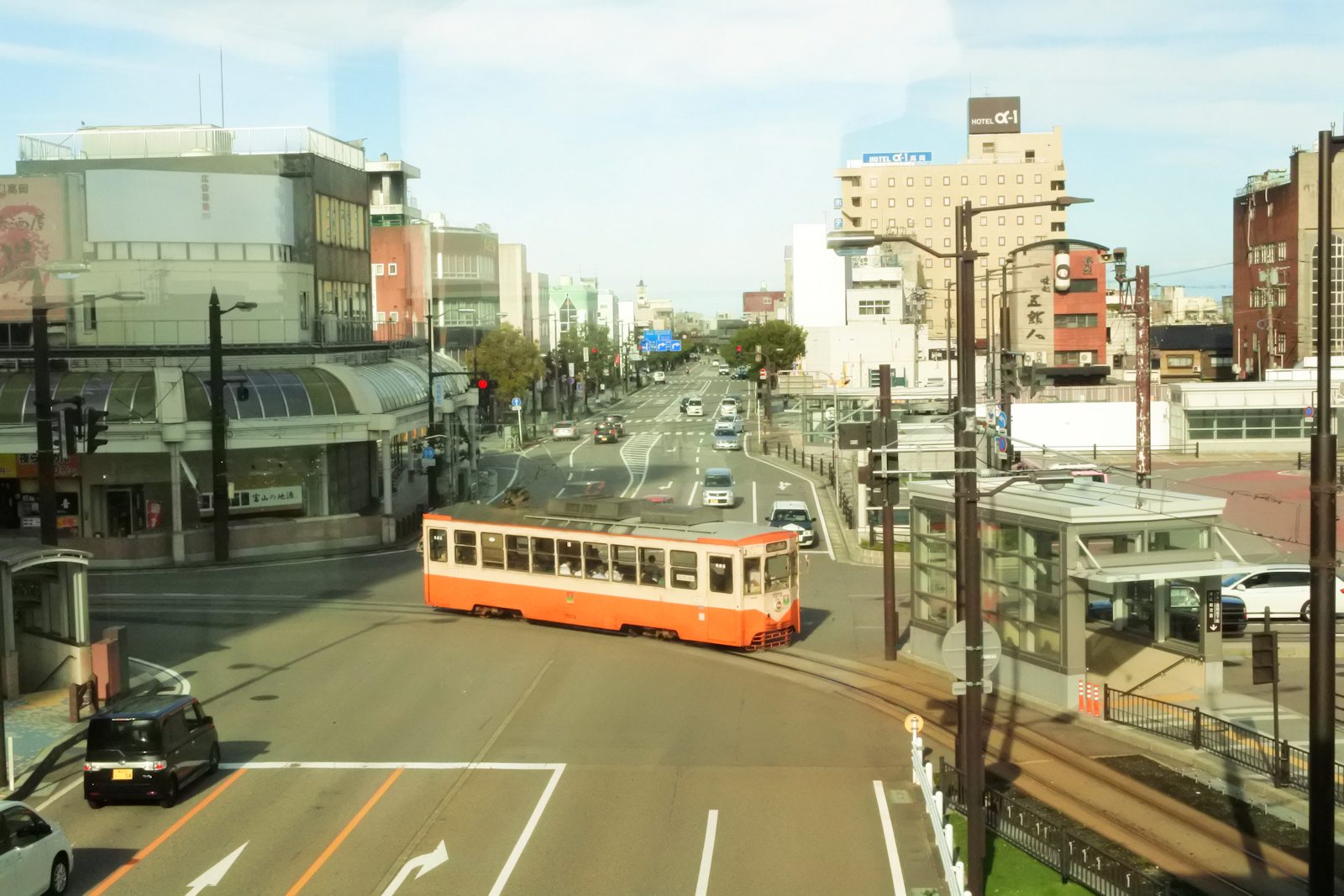
高岡駅前で、万葉線デ7070形電車7073号車を撮影。前回2009(平成21)年にも万葉線を撮影したのだが、その時はMLRV1000形電車しか撮ることができなかった。デ7070形電車は今回が初撮影であった。なかでも7073号車は、2016(平成28)年より万葉線の前身である加越能鉄道(現在の加越能バス)時代の塗装を復元させた車両として運行している。末広町商店街を抜けて高岡駅電停へ向かうデ7070形7073号車まずは高岡駅と複合施設「ウイングウイング高岡」とをつなぐペデストリアンデッキから撮影。7073号車の運行時刻は万葉線のWebサイトで公開されているため、事前に調べてから撮影に臨むことができる。先ほど乗ったあいの風とやま鉄道線の列車が高岡駅に到着する時刻が、ちょうど7073号車が高岡駅電停に来る時刻に近かったことから、撮影に成功した。末広町商店街を走るデ7070形電車7073号車 高岡駅電停~末広町電停間にて続いては高岡駅前交差点から撮影。7073号車は、9月2日に劇場公開されたアニメ「君の膵臓をたべたい」の作中にも描かれている車両であり、3枚目の写真はロケ地マップにも載せられたワンシーンを参考に越ノ潟方を臨む構図で撮影した。同作とタイアップして、越ノ潟行きが高杉真宙さん、高岡駅行きがLynnさんの声による車内アナウンスを流している。残念ながらこの日は万葉線に乗っている時間がなかったことから、7073号車に乗ってアナウンスを聞くことができなかったが、期間中にもう一度7073号車が稼働している日を狙ってまた来たいと思っている。At Takaoka Station, I photographed De 7070 Series no.7073 on Manyosen tramway, whose body is painted in the old orange-and-beige-coloured livery in the Kaetsuno Railway (Present Kaetsuno Bus) period since 2016. Last time I had photographed Manyosen tram, I could have done only MLRV1000 Series, so it was first time for me to do De 7070 Series.The first photograph was shot from the pedestrian deck connecting between the station building and complex building "Wing Wing Takaoka", coming from Koshinokata Tram Stop. The timetable of 7073 is shown on the website of Manyosen and I had found that it came there in a few minutes later than the time of Ainokaze Toyama Railway Line train which I travelled arrived.The second and third photographs were shot near Takaoka Station road crossing. The third one is based on a scene from an animated film "I Want to Eat Your Pancreas". Manyosen ties up with this anime; 7073 is pictured in the work and the announcement of 7073 is performed by two voice actors, Mahiro Takasugi (Koshinokata-bound) and Lynn (Takaoka-bound) until March 31st, 2019. Because I didn't have time to travel with Manyosen, I couldn't hear the announcement. However, I want to go there again to travel with 7073 and to listen to the announcement.劇場アニメ「君の膵臓をたべたい」公式ガイドブック [ 君の膵臓をたべたい アニメフィルムパートナーズ ]楽天で購入
Sep 19, 2018
コメント(0)
-

立山・黒部アルペンルートと富山県の鉄道を巡る旅 あいの風とやま鉄道線初乗車
黒部峡谷鉄道本線を1往復した後、宇奈月温泉駅から富山地方鉄道本線で新魚津駅へ。そこから隣接するあいの風とやま鉄道線魚津駅へとやって来た。ここからあいの風とやま鉄道線の列車に乗った。あいの風とやま鉄道線は、2015(平成27)年のJR東日本・JR西日本北陸新幹線長野駅~金沢駅間の開通と同時に、それまでJR西日本北陸本線の一部だった倶利伽羅駅~市振駅間(より正確には倶利伽羅駅~石動駅間にある石川・富山県境から越中宮崎駅~市振駅間にある富山・新潟県境までの区間)を、富山県などが出資して設立された第三セクターであるあいの風とやま鉄道が引き継いだ路線。僕は北陸本線時代には乗ったことがあったものの、あいの風とやま鉄道線となってからは、今回が初めての乗車であった。今回乗車したのは、魚津駅から高岡駅までの区間。車両は自社所属の521系電車。JR西日本521系電車と同型の車両であり、JR西日本からあいの風とやま鉄道へ譲渡された編成が多数派であるが、あいの風とやま鉄道が自社発注した編成も一部存在する。車体側面には、海側には青色、山側には緑色の「風」をイメージした模様が入る点が、JR西日本所属車両との違いである。来た列車はJR西日本から譲渡された“223系顔”の編成での運行だった(ちなみに自社発注車両はすべてJR西日本521系の3次車に準じた“225系顔”である)。魚津駅~滑川駅間は富山地方鉄道本線との並走区間である。前日の9月18日に同線の列車から見た風景を、この日はあいの風とやま鉄道線の列車に乗って、逆方向に向かいながら見る。富山地方鉄道本線の小さな駅を横に見ながら駆け抜けていく。あいの風とやま鉄道線の列車は2両~4両編成で運行されているものの、北陸本線時代の名残で、各駅のホームは列車編成長よりもかなり長いものである。富山地方鉄道本線との乗換駅である魚津駅と滑川駅の両線のホームを見比べると一目瞭然である。車窓から見える景色について言えば、あいの風とやま鉄道線は富山県の七大河川(黒部川・片貝川・早月川・常願寺川・神通川・庄川・小矢部川)をすべて渡ることが特筆される。今回の乗車区間では、魚津駅~東滑川駅間で早月川、水橋駅~東富山駅間で常願寺川、富山駅~呉羽駅間で神通川、越中大門駅~高岡駅間で庄川の4つの川を通過する。滑川駅を発車し、富山地方鉄道本線中滑川駅を過ぎると同線と別れる。水橋駅・東富山駅と停車し、列車が富山駅に近づいてくると、進行方向左側の車窓に富山貨物駅・富山機関区が見えた。線路上にはEF81形電気機関車やEF510形電気機関車が停まり、たくさんのコンテナを積んだ貨車が並び、線路脇には積み下ろされたコンテナが重ねられていた。JR西日本金沢総合車両所富山支所・あいの風とやま鉄道運転管理センターも併設されており、同車両基地所属のJR西日本のキハ120系気動車(高山本線用)、あいの風とやま鉄道の521系電車の姿が見えた。富山貨物駅を離れ、進行方向左側にJR西日本北陸新幹線の高架線と、滑川駅~水橋駅間で別れた富山地方鉄道本線の線路と接近すると富山駅へ入線する。富山駅は北陸新幹線開通後に、あいの風とやま鉄道線上り(高岡・金沢方面行き)列車とJR西日本高山本線の列車が発着するホームが高架化された。列車は新幹線ホームのすぐ隣の1番のりばに到着した。新幹線ホーム側を見ると、東京行きの「はくたか」として運行していたE7系が発車していく姿が見えた。2018(平成30)年現在、あいの風とやま鉄道線下り(魚津・黒部・泊方面行き)列車が発着するホームが高架化工事中である。高架線を下りると、北陸新幹線としばらく並走する。進行方向左側に並んでいた新幹線の高架線をアンダークロスすると、まもなく呉羽駅に到着した。この先の小杉駅~越中大門駅間でもう一度北陸新幹線の高架線をアンダークロスした。越中大門駅発車後、庄川橋梁を渡ると、高岡駅はもうすぐである。高岡駅はあいの風とやま鉄道線のほか、JR西日本氷見線・城端線、万葉線との乗換駅であり、北陸本線時代は「雷鳥」「しらさぎ」「はくたか」などの特急列車の多くが停車していた、富山駅と並ぶ主要駅である。この区間の各停列車に乗るのは2009(平成21)年以来であった。かつては大阪駅や名古屋駅から数多くの特急列車が運行されていた北陸本線も、北陸新幹線開通後は、特に今回乗車したあいの風とやま鉄道線となった区間では、特急列車が全廃されたことから、すれ違う車両のバリエーションが乏しくなってしまった。しかし高架化と新幹線の開通で変わろうとしている富山駅を初めて見たことは、時代の変化を間近に感ぜられ、とても印象的だった。After travelling on Kurobe Gorge Railway Main Line, I came to Uozu Station by Toyama Chiho Railway Main Line to transfer to Ainokaze Toyama Railway Line, which was inherited a part of JR West Hokuriku Main Line in Toyama Prefecture between Kurikara Station and Ichiburi Station (more properly between the border with Ishikawa Prefecture, between Kurikara Station and Isurugi Station, and that with Niigata Prefecture, between Etchu-miyazaki Station and Ichiburi Station), by Ainokaze Toyama Railway Company, a mixed enterprise which is established by Toyama Prefecture, municipal organisations along the railway, and private companies, at the same time as the open of Hokuriku Shinkansen in 2015.I have travelled on this section several times in JR period, but it was first time to do after the business succession.On that time, I travelled from Uozu Station to Takaoka Station and a 521 Series set which moved from JR West.Ainokaze Toyama Railway Line runs in parallel with Toyama Chiho Railway Main Line, on which I had travelled on the day before that day, between Uozu Station and Namerikawa Station. Though the Ainokaze Toyama Railway Line train is operated by up to 4-car set, the platform of the stations is very longer than the train because of the train length of that in the JR period.It can be a attractive feature that Ainokaze Toyama Railway Line crosses all of the seven biggest rivers in Toyama Prefecture, Kurobe River, Katakai River, Hayatsuki River, Joganji River, Jinzu River, Shogawa River, and Oyabe River. While travelling, the train did four, Hayatsuki River between Uozu Station and Higashi-namerikawa Station, Joganji River between Mizuhashi Station and Higashi-toyama Station, Jinzu River between Toyama Station and Kureha Station, and Shogawa River between Etchu-daimon Station and Takaoka Station.The line diverges from the railway of Toyama Chiho Railway Main Line between Namerikawa Station and Mizuhashi Station. Then, as the train coming close to Toyama Station, Toyama Rail Yard was seen on the left of train direction, in which the carriages,such as Class EF81, EF510 electric locomotive, Kiha 120 Series on JR West Takayama Main Line, Ainokaze Toyama Railway 521 Series, and lots of freight train stayed, and the containers unloaded from the freight trains were stored. While stopping Toyama Station, I saw a Shinkansen train "Hakutaka" Departing toward Tokyo Station.Going over the turnout branching to the yard, the railway of JR West Hokuriku Shinkansen and Toyama Chiho Railway Main Line start to spread in parallel with the railway and the train soon dropped into Toyama Station, whose tracks of Ainokaze Toyama Railway Line (toward Takaoka and Kanazawa) and JR West Takayama Main Line had been elevated soon after the open of Shinkansen and that of Ainokaze Toyama Railway Line (toward Uozu, Kurobe, and Tomari) is under construction.Going down the elevated section, the railway spread in parallel with Shinaknsen and crossed under that twice, soon before arriving at Kureha Station and between Kosugi Station and Etchu-daimon Station.After crossing Shogawa River, the train came to Takaoka Station, one of the biggest stations on Ainokaze Toyama Railway Line connecting to JR West Johana Line, Himi Line, and Manyosen tramway and many limited express trains used to stop in the JR period. My last travel with a local train on this section had been in 2009, the JR period. The variation of the carriages in service became less because of the end of all limited express train operation associated with the open of Shinkansen and business succession of Hokuriku Main Line. However, while watching Toyama Station, currently rebuilding, I felt changes of the times compared with that in my last visiting, which is very impressive.10-1437 あいの風とやま鉄道521系 2両セット[KATO]《発売済・在庫品》楽天で購入
Sep 19, 2018
コメント(0)
-

立山・黒部アルペンルートと富山県の鉄道を巡る旅 黒部峡谷鉄道本線に乗る
3日目の9月19日は、ホテルの窓から見た黒部峡谷鉄道本線に乗車。新山彦橋を渡る黒部峡谷鉄道本線の列車 A train on Kurobe Gorge Railway Main Line crossing Shin-yamabiko Bridge「黒部峡谷トロッコ電車」という愛称で呼ばれる黒部峡谷鉄道本線は宇奈月駅~欅平駅間を結ぶ路線。もともと黒部川での水力発電所建設のための資材運搬を目的とした電力会社の専用鉄道として建設された。2018(平成30)年現在も、黒部峡谷鉄道は関西電力の子会社である。その証拠に、同社の社章は関西電力の社章にレールの断面図を組み合わせたものである。黒部峡谷鉄道本線には関西電力の社員専用列車が運行されているほか、中小民鉄では珍しくなった貨物列車も今なお運行されている。同線の駅は宇奈月駅・黒薙駅・鐘釣駅・欅平駅を除いて関西電力社員のみが乗り降りできるものである。線路の幅(軌間)は762mmのナローゲージと呼ばれるものである。762mm軌間を採用している路線は、2018(平成30)年現在旅客営業を行っているものでは、黒部峡谷鉄道本線のほか、三岐鉄道北勢線と四日市あすなろう鉄道内部線・八王子線のみである。黒部峡谷鉄道本線のトロッコ電車には、普通客車(1000形)、特別客車(2000形)、リラックス客車(3000形及び3100形)という3種類の車両があり、僕は黒部峡谷の自然を肌で感じたいという理由から、窓がない普通客車を選んだ。客車は13両編成で、EDR形電気機関車25号車・26号車が牽引した。宇奈月駅を発車した列車は、新山彦橋を渡り、宇奈月ダムを進行方向右側に見ながら走る。宇奈月ダムは黒部川にあるダムの中では最も新しいもので、2001(平成13)年に完成した。加えて他のダムが水力発電用に建設されたのに対して、この宇奈月ダムは発電用としても使われているものの、治水(水道水の供給や洪水対策)を主な目的として建設されたことから、黒部川にあるダムの中では唯一関西電力ではなく国土交通省の所有・管理であることが大きな違いである。そんな宇奈月ダム(宇奈月湖)の線路側のほとりには、ヨーロッパの古城を思わせる佇まいの新柳河原発電所がある。その新柳河原発電所に近い柳橋駅は関西電力社員専用の駅であるが、列車は運転停車した。この先も同様のすべての駅に運転停車した。黒部峡谷鉄道本線の一般旅客が乗降可能な駅と関西電力社員専用駅の大きな違いは、ホームに屋根があるかないかと言える。一般旅客が乗降可能な宇奈月駅・黒薙駅・鐘釣駅・欅平駅のホームには屋根があり、それ以外の関西電力社員専用駅のものにはない。なかには笹平駅のように、ホームらしきものすら見当たらない(宇奈月方面行き列車が走る線路のみ)ものもある。柳橋駅~森石駅間の車窓から view between Yanagibashi Station and Moriishi Station列車は緑が美しい黒部峡谷の川の流れに沿って、右に左にカーブを繰り返し、そしていくつものトンネルを抜けながら山を上っていく。列車の車内放送は、富山県出身の女優・室井滋さんの声によるもの。景色の解説や観光案内はもちろんのこと、黒部峡谷鉄道の豆知識や富山弁クイズなどを、特徴ある声で話している。出平駅手前に見える出し平ダム Dashidaira Dam near Dashidaira Station猫又駅の手前に黒部川第二発電所が見える Kurobe No.2 Power Plant near Nekomata Station車窓から見える黒部川 2枚とも猫又駅~鐘釣駅間 View of the river between Nekomata Station and Kanetsuri Station鐘釣駅では他の駅には見られない特徴がある。同駅のホームは、欅平行き列車が発着するものは欅平方の、宇奈月行き列車が発着するものは宇奈月方の一部が、それぞれ引込線(安全側線)にまで伸びていることから、両方面行きの列車とも、発車する時にはいったん後ろへ引き返してから本線へと戻る。80分ほどの乗車で終点の欅平駅に到着した。線路はこの先、黒部川第四発電所方面へと、関西電力黒部専用鉄道が続いているが、一般旅客が立ち入ることができるのは、ここ欅平駅まで。欅平駅ホーム From platform of Keyakidaira Station欅平駅の屋上展望台から宇奈月駅へと向けて出発する準備をしている列車と新黒部川第三発電所を入れた峡谷の写真を撮影。黒部川、美しい緑、黒部峡谷鉄道本線の列車、そして水力発電所と、黒部峡谷を象徴するものを1枚に収めた。黒部川の欅平駅よりも上流は、初日の9月17日に見た黒部ダムへと続いている。黒部ダムの堰堤から勢いよく飛沫を上げて飛び出した水が、やがて黒部峡谷鉄道本線の列車から見える清流になるのである。そして、宇奈月行き列車で来た道を戻った。もちろん今度も普通客車で。宇奈月行き列車を牽引していた電気機関車は、2012(平成24)年にデビューした黒部峡谷鉄道初のVVVF制御を採用したEDV形車両34・35号車であった。涼しげな川の流れ、美しい緑、爽やかな風。窓のない普通客車だからこそ、肌で感じられる自然が黒部峡谷鉄道本線にはあった。以前から美しい黒部峡谷を列車に乗って見てみたかっただけに、ものすごく印象的な旅だった。列車の車窓から見えたダム・発電所が連続する電気を作り出す川としての姿と、美しい峡谷を作り出した姿、黒部川の2つの姿を見ることができた。電力供給に適していることを発見した人によってダムと発電所が数多く作られた黒部川を見ていると、人と自然の共存についても考えさせられた。On the third day, September 19th, I travelled with Kurobe Gorge Railway Main Line, which connects between Unazuki Station and Keyakidaira Station and originally opened as an industrial railway carrying construction materials for power plants building along Kurobe River built by an electric power company.In 2018, Kurobe Gorge Railway is a branch company of Kansai Electric Railway, which is told by company symbol, consisting of that of Kansai Electric Power Company and cross-section of a rail. The trains only for the power plant workers and the freight trains keep operating. Among its ten stations, six stations, except Unazuki, Kuronagi, Kanetsuri, and Keyakidaira Stations, are only for the power plant workers.It had been laid with track gauge of 762mm/30in, which is introduced by Sangi Railway Hokusei Line, Yokkaichi Asunarou Railway Utsube Line, and Yokkaichi Asunarou Railway Hachioji Line only in Japan.The three types of carriages, windowless (1000 Series), Special Class (2000 Series), and Relax Class (3000 or 3100 Series), on Kurobe Gorge Railway Main Line exists, but I chose windowless carriage because I wanted to feel the atmosphere in my bones.The train I rode on was consisted of 13 cars and hauled by Class EDR electric locomotive 25 and 26. Departing from Unazuki Station, the train crossed Shin-yamabiko Bridge over Kurobe River and started to run beside the river. On the right of the train's direction, Unazuki Dam, the latest dam on the river and has function since 2001, is located. Among the dams in Kurobe River, Unazuki dam is only one multifunctional one, mainly functions as flood control facility and storage for daily life water, as well as for power plant, and managed by Ministry of Land, Infrastructure, Transport and Tourism. Beside the dam reservoir, a castle-like building stands, which is Shin-yanagawara Power Plant (third photograph).Near the power plant, Yanagibashi Station, only for power plant workers, is located and the train stopped. Further than there, though the passengers couldn't get on or off, the train stopped all of .While travelling, I noticed that it is very different not to equip roof from where passengers can get on or off, especially, the track for Unazuki-bound train of Sasadaira Station doesn't have platform.The train kept running along the river and over series of curves, tunnels, and bridges.The announcement is performed by a Japanese actress from Toyama Prefecture, Shigeru Muroi, which is about not only tourists attraction, but also knowledge about the railway and words in Toyama accent.The second passenger-accessible station, Kanetsuri, has unique railway layout; both of the two platforms partly stand beside the turnouts. When the train depart from there, it once goes back before the switch and forward again to the main line.It took about 80 minutes from end to end. From there, Kansai Electric Power Company Industrial Railway toward Kurobe No.4. Power Plant directly connects, but Kurobe Gorge Railway passengers can't go further than there.At the roof of the station building, I photographed the gorge scenery with Shin-Kurobe No.3 Power Plant and train (tenth photograph). While watching the view, I noticed that the river water streams from Kurobe Dam which I watched two days before.The train I rode on on the way back was hauled by Class EDV 34 and 35, which debut in 2012 and first equip variable frequency controller among Kurobe Gorge Railway electric locomotive.Because I chose a windowless car, I could feel the atmosphere of beautiful gorge not only through eyes but also with all my senses. While travelling, I could see the two aspects of the river, one as source of power generation, and one creating beautiful landform. Watching the dams and power plants, I also considered how people live in coexistence with nature.
Sep 19, 2018
コメント(0)
-

立山・黒部アルペンルートと富山県の鉄道を巡る旅 黒部峡谷鉄道本線が見えるホテル黒部
黒部峡谷鉄道本線のトロッコ電車から見たホテル黒部 Hotel Kurobe photographed from a train on Kurobe Gorge Railway Main Lineこの日は宇奈月温泉に宿を取った。富山地方鉄道本線宇奈月温泉駅および黒部峡谷鉄道本線(黒部峡谷トロッコ電車)宇奈月駅から歩いて13分ほどのところにあるホテル黒部。黒部川のほとりに建つこのホテルの魅力は、すべての部屋、玄関付近のロビー、そして風呂(大浴場・露天風呂とも)から美しい黒部渓谷の絶景と黒部峡谷鉄道本線の線路が見えること。僕が案内された部屋は、近年リニューアルされたばかりの「YAMABIKO」と名付けられた和洋室。部屋の窓からは、黒部峡谷鉄道本線の撮影ポイントとしても知られる新山彦橋が見える。窓から見える山彦橋を渡る黒部峡谷鉄道本線のトロッコ電車 A train on Kurobe Gorge Railway Maini Line from the guestroom windowロビーにも鉄道ファン垂涎のものがある。かつて黒部峡谷鉄道本線で使われていた信号機やポイントの進路を表示する転轍機標識、そしてかつて同線で活躍した車両の銘板やマスコンハンドル、かつて使われていた運転士用時刻表などが展示されている。部屋や風呂から黒部峡谷鉄道本線が見えるという理由で、このホテルを選んだことは言うまでもない。2枚目の写真のような部屋からのトロッコ電車のある景色の美しさはもちろんのこと、露天風呂ではトロッコ電車見たさについつい長風呂してしまった。それほど鉄道ファンが楽しめるホテルであると、僕は言いたい。On that day, I made a reservation for a hotel in Unazuki Hot Spring, Hotel Kurobe, where stands at riverside and the greenish scenery of Kurobe Gorge and the trains on Kurobe Gorge Railway Main Line from the window of all guestrooms, lobby, and communal bathroom. It takes about 13 minutes on foot from Unazuki-onsen [Unazuki Hot Spring] Station on Toyama Chiho Railway Main Line or Unazuki Station on Kurobe Gorge Railway Main Line.The room I stayed were called "Yamabiko", refurbished in recent years, and mainly consisted of tatami flooring room and semi-open wood flooring bedroom. From the bedroom window, Yamabiko Bridge on Kurobe Gorge Railway Main Line, which is known as one of the famous photograph spot among railfans, could be seen.More things which attract railfans are displayed in its lobby, Kurobe Gorge Railway Main Line such as railway signal and switch sign which used to be stood on the side of the railway, plate and master controller, etc. of retired car, and old timetables for train drivers.Needless to say, I chose this hotel because of the view of the Gorge and the train. Like the second photograph, I could enjoy watching not only the view from the guestroom window, but also that from the communal bathroom and open-air bath, especially at open-air bath, I took long time to wait a train to come where I could watch. It can be say that the hotel attracts railfans so much.黒部峡谷・宇奈月温泉 ホテル黒部
Sep 18, 2018
コメント(0)
-
立山・黒部アルペンルートと富山県の鉄道を巡る旅 富山地方鉄道立山線・本線 特急「アルペン1号」
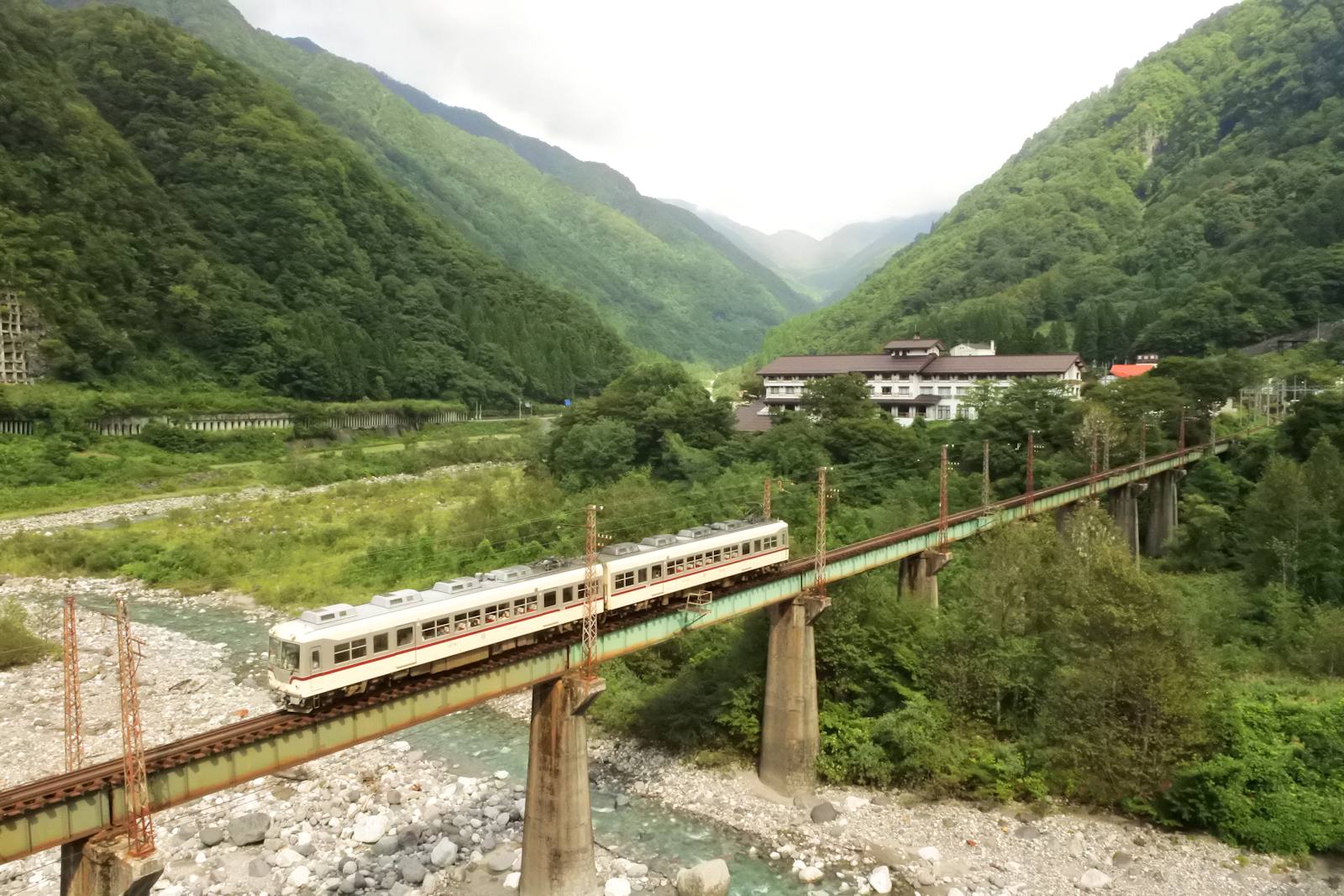
立山・黒部アルペンルートの旅は無事にゴールである立山駅に着いた。ここからはアルペンルート以外の富山県内の鉄道路線の旅が始まる。最初に乗る列車は、富山地方鉄道立山線・本線の特急列車「アルペン1号」。立山駅~宇奈月温泉駅を走る列車であり、寺田駅、上市駅、中滑川駅、電鉄魚津駅、新魚津駅、電鉄黒部駅、新黒部駅に停車。車両は富山地方鉄道14760形電車のモハ14765-モハ14766編成。各停列車や急行列車としても運行される車両であるが、この「アルペン1号」をはじめとする特急列車として運行する時は、乗車するには特急券が必要である。富山地方鉄道の特急券はJR各社のものと同様に自由席券と指定席券とがあり、14760形で運行される列車への乗車に必要なのは自由席券の方である。立山駅を発車後、常願寺川にかかる真川橋梁(上写真)を渡り、その後も川沿いを走る。カーブが多いため、ゆっくりとしたスピードで、川沿いの森の中を走る。立山駅~本宮駅間の道のりは4.8km、これは富山地方鉄道で最も長い駅間距離である。この区間は各停列車でも11分を要する。本宮駅の次の有峰口駅を通過し、再び常願寺川にかかる鉄橋(千垣橋梁)を渡ると、いよいよ列車は加速し、特急列車らしい走りを見せ始めた。有峰口駅から数えて2駅目の横江駅を通過すると常願寺川と離れ、車窓には田んぼが広がる。その次の不二越・上滝線が分岐する岩峅寺駅付近から山間部を抜けて富山平野へと入った。列車は富山平野の水田地帯を快走、沢中山駅、釜ヶ淵駅、下段駅、榎町駅、五百石駅、田添駅、稚子塚駅の順番に通過していった。いよいよこの列車の最初の見所である寺田駅に到着する。寺田駅で列車は進行方向を変え、立山線から本線へと移るのだが、立山線のホームから本線の宇奈月温泉方面へ線路がつながっていないため、特異なやり方で進路転換する。まず列車は立山線のホームに到着し、いったん両線の線路が合流するポイントがある電鉄富山方へ向かう。ポイントを通り過ぎた踏切付近で一時停止してポイントが本線側に切り替わるのを待ち、ここで進行方向を変えて本線のホームへと入線する。寺田駅では、「アルペン1号」の場合は、基本的に立山線ホームは降車専用、本線ホームは乗車専用である。本線に移った列車は東向きに進路を変える。ここから越中泉駅、相ノ木駅、新相ノ木駅を通過。次の停車駅である上市駅では、2回目の進行方向転換が行われる。上市駅での転換は、寺田駅のもののような複雑なものではない。再び進行方向を変えた列車は、進行方向右にカーブして北進する。この先も水田地帯が広がっている。途中の中加積駅~西加積駅間でJR西日本北陸新幹線の高架をアンダークロスする。西滑川駅で右にカーブし、北東方向に進路を変える。進行方向左側にあいの風とやま鉄道線の線路が見えてくると、次の停車駅である中滑川駅へと入線する。中滑川駅から新魚津駅までは富山地方鉄道本線とあいの風とやま鉄道線との並走区間。経田駅の手前まで両線の線路は並んでいる。並走区間途中の越中中村駅~西魚津駅間の早月川橋梁を渡った先で、大きくS字カーブを描きながらあいの風とやま鉄道線をアンダークロスして、今度は進行方向右側に同線を見ながら走る。西魚津駅の先で盛り土から高架へと上がると電鉄魚津駅に到着する。電鉄魚津駅発車後、あいの風とやま鉄道線を走る521系電車(JR西日本521系電車と同型車両)が後ろから近づき、同線魚津駅に隣接する新魚津駅に到着するまで並走した。新魚津駅~経田駅間であいの風とやま鉄道線と別れ、経田駅の次の電鉄石田駅で17480形電車(元東急8590系電車)の各停電鉄富山行き列車とすれ違った。すれ違った編成は、元デハ8593号車とデハ8693号車から成るモハ17483-モハ17484編成。東急レッドとオレンジ色のグラデーションカラーの帯を前面に巻いたその姿は、東急電鉄在籍時代末期と同じだった。(参考:東急大井町線在籍当時の東急8590系電車8691F)電鉄石田駅~電鉄黒部駅間で進行方向右にカーブしながら盛り土に上がると、いったん別れたあいの風とやま鉄道線をオーバークロスした。窓を見てみると、同線の線路には先ほど新魚津駅付近で出会った列車が走っているのが見えた。進路を東向きに変えた列車は盛り土を下り、地上に戻ると次の停車駅の電鉄黒部駅に到着した。電鉄黒部駅発車後、東三日市駅、荻生駅を過ぎて長屋駅を通過すると、中加積駅~西加積駅間に続いて再び北陸新幹線の高架線が見えてきた。新幹線をアンダークロスすると、すぐに次の停車駅である新黒部駅に到着した。新黒部駅は新幹線の黒部宇奈月温泉駅に至近の乗換駅として2015(平成27)年に開業した。富山地方鉄道の駅としては、市内線の富山駅前電停と並んで最新のものである。新黒部駅発車後も水田地帯を走り抜け、下立駅~愛本駅間で黒部川沿いの立山連峰と後立山連峰の谷間へと入る。順調に走り続けていた列車だったが、愛本駅の次の内山駅の手前で停止信号の現示により一時停止した。宇奈月温泉方からやってくるはずの電鉄富山行き列車が遅れていたための停止であった。数分の信号待ちで再び列車が動き出した。内山駅・音沢駅を通過すると、いよいよ次は終点の宇奈月温泉駅である。音沢駅~宇奈月温泉駅間の道のりは3.8kmと、先ほど走ってきた立山線の立山駅~本宮駅間に続いて、地鉄においては2番目に長い駅間距離である。宇奈月温泉駅に近づくにつれて、立山連峰・後立山連峰の山々が大きく見えてきた。トンネルを2つ抜けると宇奈月の温泉街がへと入り、黒部川の支流である宇奈月谷川にかかる鉄橋を渡ると、間もなく宇奈月温泉駅に到着した。立山駅を発車してから1時間40分強の旅だった。立山線は2度目の乗車であったが、本線のうち寺田駅~宇奈月温泉駅間の乗車は今回が初めてだった。富山平野の岩峅寺駅~下立駅間は水田が広がる田園地帯に、地元に根差した民鉄の路線の列車が走り、駅のホームも多くが1面しかない単式の無人駅が建つ風景が、古めかしい農村の雰囲気を醸し出していた。一方山間部の立山駅~岩峅寺駅間と下立駅~宇奈月温泉駅間は、木々の緑が目の癒しになった。どちらも富山県の自然の恵みと言えるだろう。寺田駅の進行方向転換は一度実際に列車に乗って見てみたかった。そして、東急電車好きとしては、17480形電車(元東急8590系電車)に出会えたことが嬉しかった。From Tateyama Station, the second attraction in this time, the travel the trains in Toyama Prefecture, started. The first was limited express "Alpine 1" bound for Unazuki-onsen [Unazuki Hot Spring] Station, in which a non-reserved limited express seat ticket is required, on Toyama Chiho Railway Tatetana Line and Main Line.Departing from Tateyama Station, the train crossed Joganji River and ran in a valley along the River. The section between Tateyama Station and Hongu Station is 4.8 kilometre- /2.98 mile-long, which is the longest on Toyama Chiho Railway Lines and on which it takes 11 minutes even by a local train. After crossing the River again between Arimineguchi Station and Chigaki Station, the train started to speed up.Around Iwakuraji [Iwakuraji Temple] Station, the train went out the valley and did into rice field area in Toyama Plain. Passing seven stations, Sawa-nakayama, Kamagafuchi, Shitadan, Enokimachi, Gohyakukoku, Tazoe, and Chigozuka Stations, the train came to Terada Station, which include the first attraction in the travel, the direction change of the train.The way of direction change is unique because of the railway layout; the turnout meeting Tateyama Line and Main Line exists only toward Dentetsu-toyama Station and the train from Tateyama Line can't go directly toward Unazuki-onsen [Unazuki Hot Spring] Station from the track for Tateyama Line. The train once went toward Dentetsu-toyama Moving to Main Line, the train went east and passed Etchu-Izumi, Ainoki, Shin-ainoki Stations. At the next stop, Kamiichi Station, the train changed its direction again.From Kamiichi Station, the train turned north and crossed the elevated railway of JR West Hokuriku Shinkansen between Naka-kazumi Station and Nishi-kazumi Station. at Nishi-namerikawa Station, the train turn north-east and the railway gets closer to that of Ainokaze Toyama Railway Line.The two lines run in parallel from near Naka-namerikawa Station to near Kyoden Station. At first, that of Ainokaze Toyama Railway Line is seen on left side of the train's direction. After crossing Hayatsuki River between Etchu-nakamura Station and Nishi-uozu Station, the railway of Main Line crosses under the other one, which starts to be seen on the right side from there. Going up an embankment and on to an elevated section, the train came to Dentetsu-uozu Station. Departing from Dentetsu-uozu Station, a train on Ainokaze Toyama Railway Line (521 Series, the same type as JR West 521 Series) came from the back of the train and the two ran almost side by side until dropping into their each next stop (Main Line's Shin-uozu and Ainokaze Toyama Railway Line's Uozu, both of which function as the structurally integrated station).The two railway gradually separated before passing Kyoden Station and the train met a local train from Unazuki-onsen [Unazuki Hot Spring] Station operated by 17480 Series (ex-Tokyu Corporation 8590 Series) Moha 17483-Moha 17484 set, which consists of two cabbed car, Deha 8593 and Deha 8693, and their front line under the window is the same one as that when they used to be in service on Tokyu Oimachi Line, red and orange colour gradation (a photograph of Tokyu Corporation 8590 Series 8691F set), at Dentetsu-ishida Station.Between Dentetsu-ishida Station and Dentetsu-kurobe Station, the train went up a curving embankment to turn right and cross over the railway of Ainokaze Toyama Railway. I could see the same train meeting Between Dentetsu-uozu Station and Shin-uozu Station from the window. Going down an embankment, the train came to Dentetsu-kurobe Station, all of whose three platforms are narrow.On the way from Dentetsu-kurobe Station, the train passed Higashi-mikkaichi, Ogyu, and Nagaya Stations. Soon before arriving the next stop, Shin-kurobe Station, the train went under the elevated railway of Hokuriku Shinkansen again. Shin-kurobe Station had opened in 2015, almost the same as the open of Hokuriku Shinkansen between Nagano Station and Kanazawa Station, as the transfer station located nearby Kurobe-unazuki-onsen [Kurobe Unazuki Hot Spring] Station and is categorised as one of the latest stations on Toyama Chiho Railway together with Toyama Station Tram Stop on Toyama Inner City Tram Line.Departing from Shin-kurobe Station, the last section to Unazuki-onsen [Unazuki Hot Spring] terminal started. The train continued to run in rice field area and went into the valley between Tateyama Mountains and Ushiro-tateyama Mountains between Oritate Station. Though the train hadn't stop except stopping stations, it first stopped near Uchiyama Station because of a red signal and the delay of a opposite-bound train. Passing Uchiyama and Otozawa Stations, the last distance of 3.8 kilometres/2.37 miles, which is the second longest section on Toyama Chiho Railway, to Unazuki-onsen [Unazuki Hot Spring] terminal started. As the train coming to the terminal, the size of the mountains from the window got bigger and bigger. Going out of two tunnels, the hotels in Unazuki Hot Spring area were seen and the train arrived at Unazuki-onsen [Unazuki Hot Spring] Station soon after crossing Unazukidani River.It took about 1 hour and 40 minutes. It was first time for me to travel on Toyama Chiho Railway Main Line between Terada Station and Unazuki-onsen [Unazuki Hot Spring] Station and second time on Tateyama Line. While travelling, I felt that the view from window, rice fields and stations with one-side platform, etc., looked the ordinary classical agricultural community. It was memorable and made me exited to watch the train's direction change at Terada Station and meeting 17430 Series.【ふるさと納税】立山黒部アルペンルート(立山駅〜扇沢駅※片道)優待券 【チケット】楽天で購入立山町ふるさと納税 寄附金の用途に「立山駅前ロータリーの無電柱化」「富山地方鉄道立山線の利用促進と駅舎、沿線景観・環境整備」あり
Sep 18, 2018
コメント(0)
-
立山・黒部アルペンルートと富山県の鉄道を巡る旅 立山黒部貫光立山高原バス・立山ケーブルカー
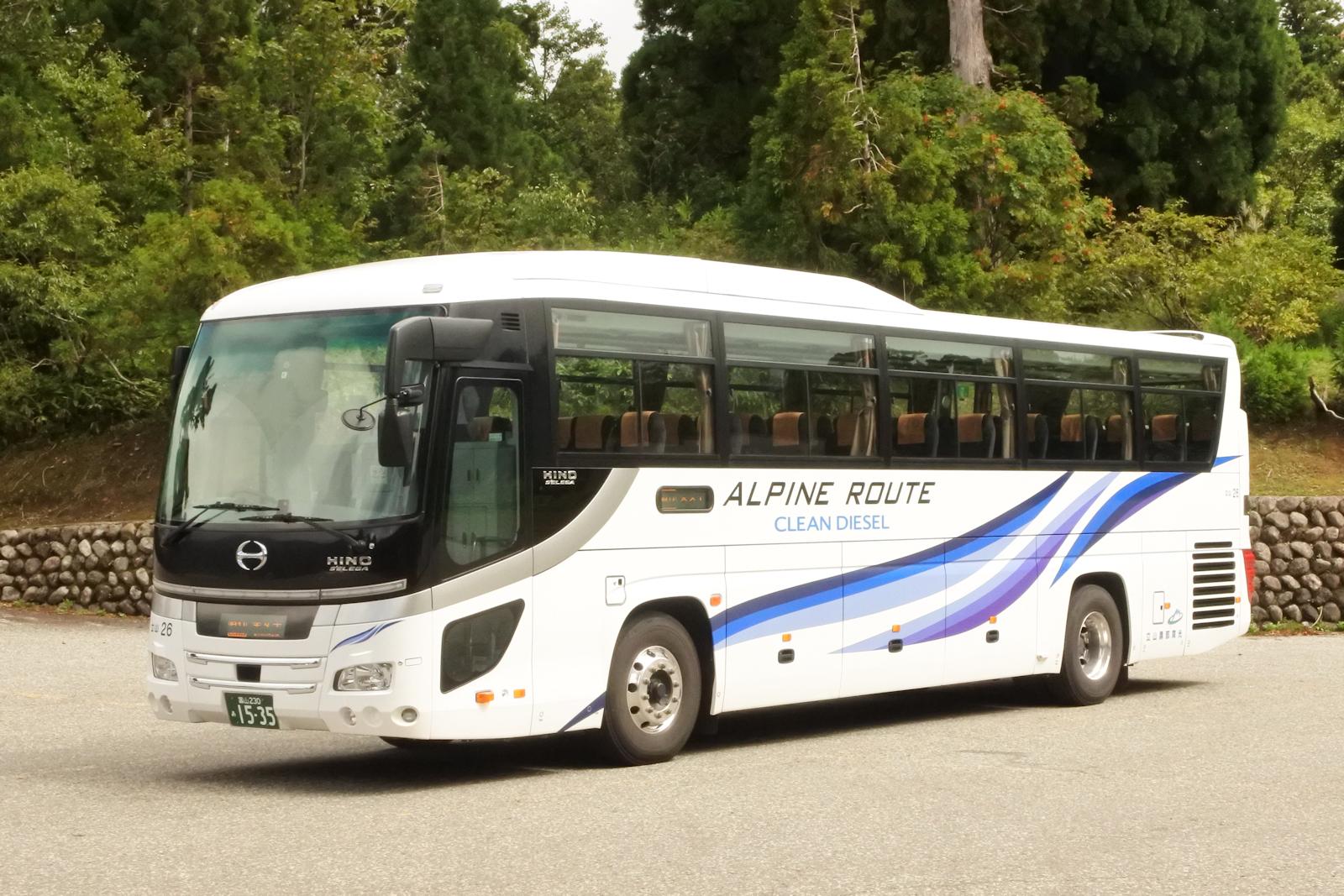
立山三山を愛でながら室堂高原(室堂平)の自然の恵みを思う存分体感した余韻に浸りながら、室堂駅から立山・黒部アルペンルートの旅を再開。ゴールである立山駅を目指して、立山黒部貫光立山高原バスと鋼索線(立山ケーブルカー)に乗る。室堂駅バス停から美女平駅バス停までを結ぶ観光路線バスである立山高原バスは、一般道(ただし乗用車の走行が不可能な立山有料道路)を走るディーゼルエンジンで駆動する観光バス車両で運行されているが、近年では環境への配慮から、ハイブリッド車やクリーンディーゼル車が活躍している。両バス停間の乗車時間は50分、標高差1473mを下る。室堂高原(室堂平)を後にして、立山三山や剱岳をはじめとする立山連峰の山々を車窓に見ながら、バスは美しい緑の草原の中を急勾配と急カーヴが続く道を走り抜ける。標高が低くなるにつれて、車窓から見える緑が草原や立山連峰の山々から立ち並ぶ木々へと変わっていく。それはやがて、美女平駅バス停に近づくにつれて森のようになっていった。美女平駅バス停に停まる立山高原バス バスはほぼ定刻に美女平駅バス停に到着した。美女平駅の前には「美女杉」と呼ばれる大きなスギの木が植えられている。美女杉は美女平の名の由来となった木である。美女杉伝説によると、立山を開山した佐伯有頼公の許婚であった姫が、有頼公に会いに立山へ行ったものの、山を開くまでは帰れないと有頼公に追い返されてしまった時の下山の折に、一本のスギの木に「美しき 御山の杉よ 心あらば わがひそかなる祈り ききしや」と祈りをささげた。するとその祈りが成就し、有頼公と姫はめでたく結ばれたそうだ。後の世になり、この伝説から、このスギの木は「美女杉」と呼ばれるようになった。美女杉に向かって姫の祈りの歌を3回唱えると、男女の隔たりなく恋が成就すると言い伝えられるようになった。そして、美女杉が植えられた周辺の地を「美女平」と呼ぶようになったという。美女平駅からは立山・黒部アルペンルートでは最後の路線である立山黒部貫光鋼索線(立山ケーブルカー)へ。立山ケーブルカーは美女平駅~立山駅間を結ぶ鋼索鉄道。両駅間の乗車時間は7分。最も急な勾配は560パーミル(29.25度)であり、高尾登山電鉄高尾鋼索線(608パーミル(31.3度))、立山黒部貫光黒部ケーブルカー(587パーミル(30.41度))、南海鋼索線(563パーミル(29.38度))に次ぐ日本で4番目に急なものである。立山ケーブルカーの車両には、他の鋼索鉄道(ケーブルカー)には見られない特徴がある。荷物用の車両が連結されていることである。車両は旅客用車両と荷物用車両の2両編成であり、荷物用の車両は立山方に連結されている。美女平駅を発車し、緑に囲まれた山をケーブルカーは下っていく。2つのトンネルを抜けて、車窓正面に称名川が見えてくると、間もなく立山駅に到着する。2日間に渡る立山・黒部アルペンルートの旅は、無事にゴールである立山駅へと着くことができた。1日目の立山ロープウェイは雨が降っていたため景色が見えなかったことが残念であったが、それ以外はすべて立山連峰や黒部ダムの素晴らしい景色を見ることが、写真を撮ることが、そして2018(平成30)年で最後を迎える関西電力関電トンネルトロリーバスに乗ることができた。それらが素晴らしい思い出になった。Coming back to Murodo Station, I restarted the travel on Tateyama Kurobe Alpine Route. On that day, I went to the goal of Alpine Route, Tateyama Station, by Tateyama Plateau Bus and Tateyama Cable Car.Tateyama Plateau Bus, connecting between Murodo Station Bus Stop and Bijodaira Station Bus Stop, runs on bus-only Tateyama Toll Road by hybrid or clean diesel vehicle from the viewpoint of environmental protection. It takes about 50 minutes and the vertical gap is 1473 metre/4832.68 feet between the two bus stops. Departing from Murodo Station Bus Stop, the bus ran winding mountain road in against Mt. Tate and Mt. Tsurugi. As the bus going down the mountain, it went into in the range of trees.The bus came to Bijodaira Station Bus Stop almost on time. In front of the station building, a cryptomeria tree called "Bijo-sugi", after which Bijodaira had been named, is planted.According to the an ancient legend of the tree, a woman, who had got engaged to Ariyori Saeki, founder of Oyama Shrine on the top of Mt. Tate, had prayed the tree for her inmost wish when she had got down the mountain after she had been refused to meet Saeki. From Bijodaira Station, I transferred to the last line, Tateyama Cable Car, which connects between Bijodaira Station and Tateyama Station. It takes about 7 minutes between the two stations and its steepest slope is 560 per mill (29.25 in degree), the fourth steepest among Japanese cable car.The vehicle on Tateyama Cable Car has a characteristic point, a open freight wagon is coupled.The cable car went down in the greenish mountain. Going out of the two tunnels, Shomyo River could be seen from the front window and the cable car came to Tateyama Station, the goal of Tateyama Kurobe Alpine Route.To review the travel on Tateyama Kurobe Alpine Route, all of the scenes of mountains and Kurobe Dam, and travel, especially Kansai Electric Power Company Kanden Tunnel Trolleybus, were beautiful and memorable except the rain while travelling with Tateyama Ropeway cable car (aerial lift) on the first day.
Sep 18, 2018
コメント(0)
-

立山・黒部アルペンルートと富山県の鉄道を巡る旅 朝の室堂高原を散歩する
立山・黒部アルペンルートと富山県の鉄道を巡る旅、2日目の9月18日。前日に降った雨はその日の夕方には止み、この日は朝から空が青くきれいな晴天に恵まれた。この日の朝は立山・黒部アルペンルートで最も標高が高く、なおかつ立山連峰を間近に見ることができる室堂高原を散歩した。コースは室堂駅から「みくりが池周回コース」に加えて地獄谷展望台・雷鳥荘方面を巡るもの。室堂高原(室堂平)へは、室堂駅の屋上に直結している。階段を降りてすぐ、やや右方向に「立山」と書かれた大きな石が置かれている。その正面には立山三山を見ることができる(上の写真)。写真左から、富士の折立山、大汝山、主峰である雄山の順に並ぶ。みくりが池を手前に立山三山を臨む Mikurigaike Pond and Mt. Tateみくりが池へは、石碑とは反対の左へ進む。池の水面に室堂高原(室堂平)の緑と立山三山、浄土山(写真右)がくっきりと写っていた。噴煙と水蒸気を吐き出す噴火口の左に雷鳥荘が見える 写真奥にはかつて大阪駅~新潟駅間を結んだ寝台特急「つるぎ」や北陸新幹線「つるぎ」の列車名の由来となったことでも知られる剱岳がそびえる Mt. Tsurugi, after which "Tsurugi" overnight express used to be in service between Osaka Station and Niigata Station and Hokuriku Shinkansen "Tsurugi" is named日本一標高が高い温泉、みくりが池温泉が湧く地獄谷からみくりが池とはいったん別れて、地獄谷展望台から雷鳥荘方面へ向かう。地獄谷展望台から雷鳥荘までは、噴火口を取り囲む地形から、硫黄臭が道幅が狭く高低差も激しい難易度の高いコースである。噴火口の反対側には鉄分(酸化鉄)で赤く染まった水溜りが点在する血の池がある。地獄谷とともに立山地獄の1つに数えられる。血の池 Chinoike [Blood Pond]雷鳥荘で折り返し、地獄谷展望台へと戻ってきた。地獄谷とは反対の立山三山側を見ると、「立山の山崎圏谷」の石碑が置かれていた。「立山の山崎圏谷」とは、立山三山の雄山と大汝山の中間に見られる大昔の氷河時代にここ立山連峰にあった氷河によって削られたU字状の丸みを帯びた谷のこと。立山三山は日本国内で唯一氷河を見ることができる場所である。1904(明治37)年に山崎直方博士によって発見され、立山連峰の氷河の存在を示すものとして国の天然記念物に指定されている。再びみくりが池周回コースへ。立山三山に近づいていくと、山側にもうひとつ別の池が見える。こちらはミドリガ池である。こちらも立山三山との組み合わせが美しい。立山三山に最接近する室堂山荘を経由して、大草原を見ながら室堂駅へと戻った。ミドリガ池と立山三山 Midorigaike Pond and Mt. Tateおよそ3時間をかけてじっくりと室堂高原(室堂平)と立山連峰の雄大な自然を体感した。緑に覆われた立山連峰の山々や草原だけでなく、標高2450メートルの高原の涼しさ、今なお活発な火山活動を続ける地獄谷と、ずっと前から見たかった景色・感じてみたかった空気だっただけに、ものすごく感動した。季節が夏から秋へと移り変わろうとしている時期だっただけに、緑から紅葉しかけている葉もちらほらと見られた。天然記念物でもあるライチョウが目的であれば、繁殖期でたくさん姿を見せる5月~6月が、美しい緑の高原とみくりが池・立山三山が目的であれば、7月~9月中頃に出かけるのがお勧めであろう。次に行くとしたら、ぜひとも5月~6月にライチョウを見に室堂平へ行きたい。On the morning of the second day, September 18th, I walked on hiking course around Murodo Plateau, mainly around Mikurigaike Pond and toward Jigokudani eruptive crater and Raicho-so lodge.Going down the stairway on the roof of Murodo Station, you can come the Plateau directly. On the right hand of the stairway, the stone monument saying "Mt.Tate" stands in front of the Mountain. I photographed the three Mountains consisting of Mt. Tate (from left Mt. Fuji-no-oritate, Mt. Onanji, and Mt. Oyama) with the monument (the first image).The pond is located toward the opposite direction from the monument. Coming in front of the pond, the pond water reflected Mt. Tate and Mt. Jodo (on the right in the second image).I went another hiking course branching off from near Mikurigake hot spring lodge toward Raicho-so lodge, which is narrow path on the steep slope beside one of the other active craters and ponds. The water of the ponds, Chinoike [Blood Pond], contains iron oxide, which looks red like blood.Coming back to the Jigokudani Crater and watching Mt. Tate, a stone monument saying "Yamazaki Curl" and the explanation of the curl; the curl had been formed by glacier, which exists in Mt. Tate only in Japan, and found by a Japanese geographer, Naomasa Yamazaki.Backing to Mikurigaike Pond, I restart to walk on the course around the pond. Coming more close to the Mountains, another pond appeares, which is Midorigaike Pond. Going around Mikurigaike Pond, I came back to Murodo Station.I had about three hours to walk around and to enjoy watching the nature of Mt. Tate. Because of the fine weather, It was enjoyable to walk and see the Moutains so much, not only the greenish Mountains and plants, beautiful and cool atmosphere in 2,450 metre/8038 feet in height, active volcano crater venting plume. I saw that some leaves and plants turned their colour to red or yellow.If I have a chance to go there, I would like to see ptarmigans in May or June.
Sep 18, 2018
コメント(0)
-

立山・黒部アルペンルートと富山県の鉄道を巡る旅 室堂駅直結のホテル立山
みくりが池から見たホテル立山(室堂駅) Hotel Tateyama (Murodo Station) from Mikurigaike Pond立山・黒部アルペンルートと富山県の鉄道を巡る旅の1日目は立山黒部貫光無軌条電車線の室堂駅まで。この日の宿は、立山・黒部アルペンルートオフィシャルホテルの1つであり、室堂駅と一体になったホテル立山。立山・黒部アルペンルートで標高2450mと最も高く、なおかつ立山連峰の山々に最も近い室堂高原(室堂平)に位置している。客室の窓から山々を一望できることはもちろん、水道水やレストランの水は、立山・黒部アルペンルートのトンネル建設中に立山三山の1つである雄山直下の破砕帯から湧き出た水「立山玉殿の湧水」を使っている。大浴場の湯も、温泉ではないものの、その湧水を加熱したものである。立山の自然を楽しむための宿泊客向けのイベントもたくさん用意されている。ホテルの職員さんの案内で室堂高原・みくりが池周辺を巡る散策会や、室堂駅屋上での星空鑑賞会などがあり、標高の高さや立山連峰を間近に見る自然環境の魅力を味わうできる。このホテルの魅力を僕自身の言葉で表すと、目だけでなく肌でも立山連峰の恵みを感ずることができるホテルであると言えるだろう。僕も散策会と星空鑑賞会に参加した。午後は雨が降っていたが、散策会の最中の夕方には雨が止み、夕焼けがきれいに見えた。夜になると雲もなくなり、星空もきれいに見えた。The hotel where I stayed on the first day, September 17th, was Hotel Tateyama, one of the Official Hotels on Tateyama Kurobe Alpine Route and with which the building of Murodo Station on Tateyama Kurobe Kanko Trolleybus is combined.The hotel is located at a height of 2,450 metre/8038 feet above sea level, the highest point of Tateyama Kurobe Alpine Route, and where the guests can see the mountains from the guestrooms' window. In addition, the hotel serves springwater from a crushed zone of Mt. Oyama, one of the three mountains consisting of Mt. Tate, which had been found while a tunnel under Mt.Oyama on Tateyama Kurobe Alpine Route constructing, not only for drinking, but also as bathwater.The hotel also serves guests activities to enjoy the atmosphere, such as walking on Murodo Plateau around Mikurigaike Pond and star watching on the roof of Murodo Station. While walking on that evening, it stopped raining and I could see beautiful sunset. Moreover, I also could did stars on the night.美しい夕焼けとホテル立山(室堂駅) Hotel Tateyama (Murodo Station) in the sunsetホテル立山【ふるさと納税】山小屋等利用割引券A 【宿泊・立山黒部アルペンルート】楽天で購入立山町ふるさと納税
Sep 17, 2018
コメント(0)
-
立山・黒部アルペンルートと富山県の鉄道を巡る旅 トンネル内を走る立山黒部貫光黒部ケーブルカー・立山ロープウェイ・無軌条電車線
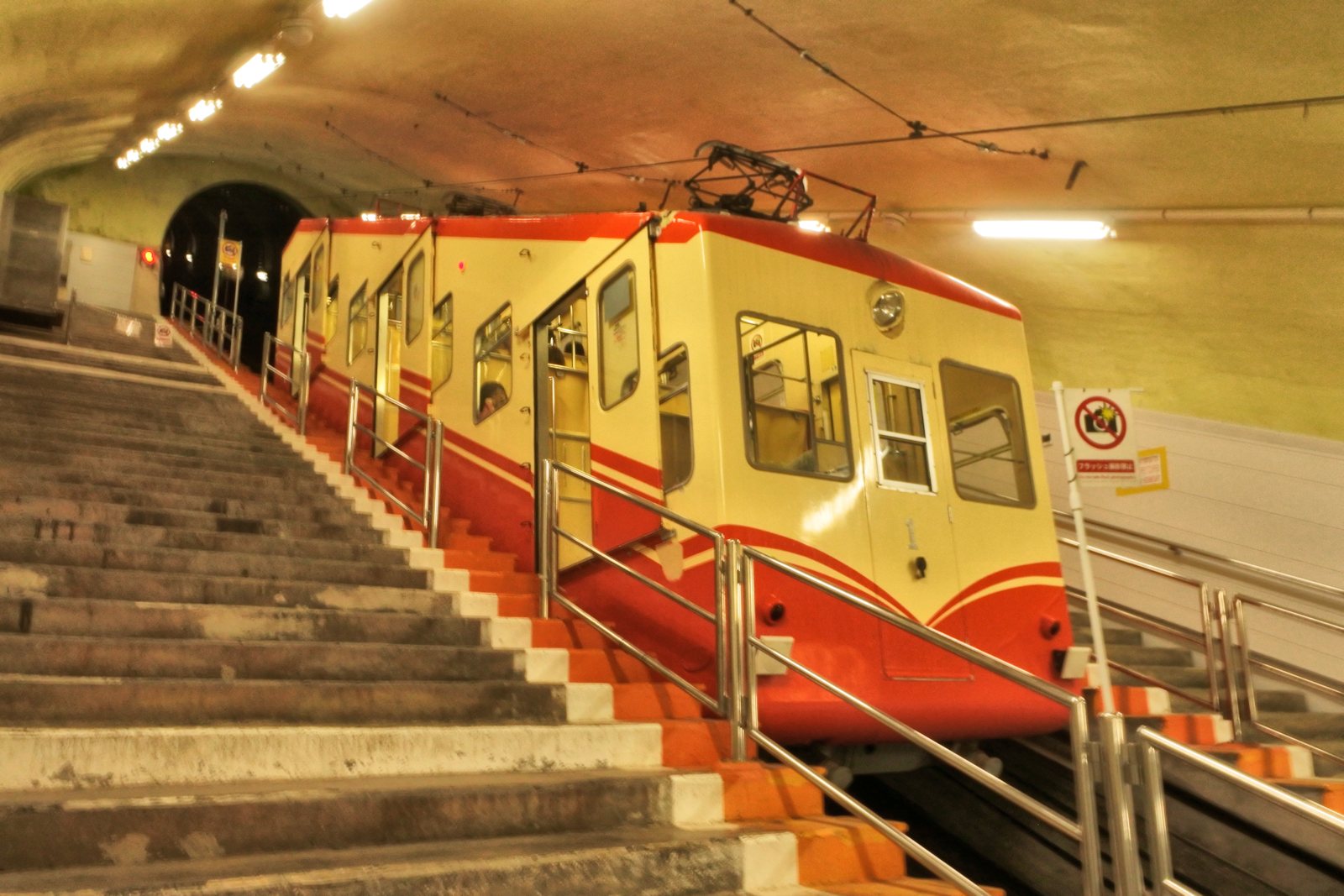
大迫力の黒部ダムと別れ、立山・黒部アルペンルートの旅を続ける。ここからは立山黒部貫光の3路線、鋼索線(黒部ケーブルカー)、立山ロープウェイ、無軌条電車線。まずは立山黒部貫光鋼索線(黒部ケーブルカー)から。黒部ケーブルカーは黒部ダム左岸の黒部湖駅~黒部平駅間を結ぶ、全線がトンネル内を走る鋼索鉄道(ケーブルカー)。全線がトンネルの鋼索鉄道はこの路線だけである。路線の中で最も急な勾配は587パーミル、角度にして30.41度。これは現存する鋼索鉄道路線のなかでは、高尾登山電鉄高尾鋼索線にある608パーミル(31.3度)に次いで2番目にきついものである。黒部湖駅~黒部平駅間の乗車時間は5分ほど。車両は1969(昭和44)年の開業当初から走り続けているもの(形式名は不明)。車内は鋼索鉄道の車両特有の階段状のものだが、角度が急なだけに1段1段が高い。僕としては、全線トンネルであるという物珍しさに加えて、車両の高い段差からも感じ取れる階段勾配のきつさが印象的だった。実際に乗ってみると、少なくとも僕がこれまでに乗った鋼索鉄道の車両のなかでは、その階段が最も急なものであると感じた。After watching Kurobe Dam, I continued travelling on Tateyama Kurobe Alpine Route. Tateyama Kurobe Kanko cable cars and trolleybus.Tateyama Kurobe Kanko Kurobe Cable Car connects between Kurobeko [Lake Kurobe (reservoir of Kurobe Dam)] Station and Kurobe-daira Station. It is also only one cable car running in underground tunnel and its maximum slope grade is 587 per mill (31.3 in degrees), the second steepest slope among cable car in Japan. It takes about 5 minutes to travel between both stations.The cable car was manufactured in and has been in service since 1969, the open of the line.While travelling, It was impressive that the cable car running in tunnel only and its steps of tiered interior was the highest among those I have ever travelled.Because of rain and dense fog, 黒部平駅では、立山ロープウェイに乗り換える。ロープウェイに乗る前に駅の外に出て景色を見た。しかし残念なことに、黒部ダムにいた時から次第に曇りはじめ、黒部平駅に着いた頃には雨が降っており、外に出てみると霧で先が見通せない程にまでになっていた。ロープウェイを入れた立山連峰の絶景の撮影には失敗した。立山ロープウェイは黒部平駅~大観峰駅間を結ぶロープウェイ(索道)。乗車時間は7分。立山ロープウェイの特徴は駅間に索条と呼ばれるを搬器(ゴンドラ)を支えるワイヤー支える柱がないワンスパン方式を採用していること。これは景観保護のためである。晴れていれば非常に美しい立山連峰が車窓から見えるはずだったのだが、前述のとおりあいにく雨が降っていたうえに霧で視界が悪かったため、ロープウェイの車窓からの景色は撮れなかった。From Kurobe-daira Station, I transferred to Tateyama Ropeway cable car (aerial lift), connecting between Kurobedaira Station and Daikanbo Station. Before getting on the aerial lift, I went out of the station to watch the scenery. While watching Kurobe Dam, the sky got cloudy, but unfortunately, it started raining. Because of the weather, I couldn't photograph the scenery of Mt. Tateyama and aerial lift.It takes 7 minutes between the two stations and no aerial lift pylon stands to keep good landscape.While travelling, you can see the beautiful mountains in a fine day, but the bad weather made no chance to me to watch and photograph the scenery.4路線目は立山・黒部アルペンルートにあるもう一つのトロリーバス、大観峰駅~室堂駅間を結ぶ立山黒部貫光無軌条電車線へ。最大で4両のトロリーバスが列をなして運行するが、この日は2両のトロリーバスが連なって運行していた。室堂駅までの乗車時間は10分ほど。この路線にも関電トンネルトロリーバスと同様に交換地点があり、トロリーバスはここで一時停止して対向のトロリーバスとすれ違う。この日の旅は室堂駅まで。The fourth transportation on the Alpine Route from Ogisawa is Tateyama Kurobe Kanko Trolleybus between Daikanbo Station and Murodo Station. The trolleybuses makes fleets of up to four cars, but it consisted of two on that day. It takes about 10 minutes between the two stations and a partial double-lane zone like a passing loop is also existed like that on Kanden Tunnel Trolleybus.The travel on that day finished at Murodo.
Sep 17, 2018
コメント(0)
-

立山・黒部アルペンルートと富山県の鉄道を巡る旅 大迫力の黒部ダムを見る
関電トンネルトロリーバスを降りて、立山・黒部アルペンルートの見どころの一つである黒部ダムを見る。黒部ダムは富山県立山町にある、黒部川にあるアーチ式コンクリートダム。戦後の好景気に伴う関西地方の消費電力増加に対応するために、関西電力の手によって建設された。工期は1956年から1963(昭和38)年までの7年間、黒部川第四発電所や作業員や資材の通り道であった大町トンネル(関電トンネル)、黒部トンネルなどの付帯施設を含む総工費は、当時の金額で513億円、作業員の総人数およそ1000万人を投じた巨大プロジェクトであった。えん堤は高さ186m、長さ492m。186mという高さは日本のダムで最大である。ダムで堰き止められてできた黒部湖は立山町と富山市に跨る。湛水面積350ヘクタール(3.5平方キロメートル)、総貯水量2億立方メートル(2000億リットル)、このうち有効貯水容量1億5000万立方メートル(1500億リットル)。黒部ダムと黒部川第四発電所、そしてその付帯施設一体は「黒四」の通称で呼ばれ、その完成までの物語は映画「黒部の太陽」やNHKのドキュメント番組「プロジェクトX」などで映像化され、後世に語り継がれている。また鉄道ファンには、かつて大阪駅~白馬駅間をJR西日本・JR東海東海道本線・JR東海中央本線(中央西線)・JR東日本大糸線経由で運行した急行列車「くろよん」の名前の由来になったことでも知られている。黒部ダムの迫力はえん堤の大きさだけではない。堤の中腹部分から黒部川へと勢いよく流れ出る水も迫力満点である。ダムからの放水は自然景観と動植物の保護を目的に、毎年6月26日から10月15日の間に行われている。放水量は期間によって異なり、6月26日~8月15日が毎秒15トン(1万5000リットル)、8月16日~10月15日が毎秒10トン(1万リットル)である。晴れの日にはダムからの放水の中に虹が見えるのだが、この日は曇っていて見えなかった。立山・黒部アルペンルートへ来たからにはぜひとも見てみたかった黒部ダムをこの目で初めて見た感想は、虹が見られなかったことは残念だったが、えん堤の大きさとそこから大量の水が流れ出る様に圧倒させられた。ダムを建設した先人の皆様方への感謝の意を表すとともに、この水が関西地方で暮らす人々の生活を支えているということに感動を覚えた。Getting off Kanden Tunnel Trolleybus, I watched Kurobe Dam, one of the attractions on Tateyama Kurobe Alpine Route and the highest dam in Japan.Kurobe Dam is a variable-radius arch dam located in Tateyama Town, Toyama Prefecture, and had been constructed between 1956 and 1963 at a cost of JPY 51.3 billion (including accompanying equipment such as Kurobe No.4 Hydropower Plant, Kanden Tunnel, and Kurobe Tunnel) by about 10 million staffs to generate more electricity supplying to Kansai Area.The Dam is 186-metre/610-foot high (the highest in Japan) and 492-metre/1614-foot wide. The dammed reservoir has the surface area of about 3.5 square kilometres/1.35 square miles with a capacity of about 200,000,000,000-liter/440,924,524,370-pound of which about 150,000,000,000-liter/330,693,393,277-pound is active/live storage.The Dam and accompanying equipment are known collectively as "Kuroyon" and films/movies or TV documentaries featuring the history of the construction of "Kuroyon" has been created several times, such as "The Sun of Kurobe" shown in 1968 and "Project X" on NHK TV broadcast in 2001. Among the railfans, "Kuroyon" express connecting between Osaka Station, Osaka Prefecture, and Hakuba Station, Nagano Prefecture, via JR West and JR Central Tokaido Main Line, JR Central Chuo Main Line (Chuo West Line), and JR East Oito Line was named after the Dam.For the purpose of saving environment, the large amount of reservoir water drains from the Dam between June 26th and October 15th every year. The bulk of tailwater is 15,000 liter/33069 pound (between June 26th and August 15) or 10,000 liter/22046 pound (between August 16th and October 15th) per second. In the fine day, you can see a rainbow in the tailwater or the sky. However, because of the cloudy weather, I couldn't on that day.While I watching the Dam, I was astonished at its scale and amount and sound of the tailwater and felt that the staffs had done hard work to solve the lack of electricity and the Dam nowadays supports the lives of persons in Kansai Area.
Sep 17, 2018
コメント(0)
-

立山・黒部アルペンルートと富山県の鉄道を巡る旅 最初で最後の関西電力関電トンネルトロリーバス
9月17日から20日にかけて、立山・黒部アルペンルートと富山県の鉄道路線を巡る旅へ出かけた。新宿駅からJR東日本中央本線(中央東線)の特急「スーパーあずさ」と同大糸線の各停列車を乗り継いで信濃大町駅へ。さらにそこから路線バスに乗って40分ほどのところに、関西電力関電トンネルトロリーバスの始発駅である扇沢駅がある。トロリーバスは、電気を動力源としていること、昔の路面電車のようなトロリーポールを屋根に備えていることが特徴。道路上に吊り下げられた架線からトロリーポールを介して電気を取り込み、タイヤに取り付けられたモーターを動かして走る。一見するとバスのようだが、実は鉄道事業法によって監督されている「無軌条電車」という立派な鉄道の一種である。関電トンネルトロリーバスは、正式には関電トンネル無軌条電車といい、黒部ダム・黒部川第四発電所(黒四発電所)の建設で工事作業員や資材運搬用車両が通行するトンネルとして建設された大町トンネルをダムの完成後に立山・黒部アルペンルートの一部として整備したもの。立山・黒部アルペンルートが中部山岳国立公園内にあるため、環境保護の観点から電気というクリーンエネルギーを動力とするトロリーバスが採用された。1964(昭和39)年の開業以来、関西電力が鉄道事業者として運行され続けてきたが、2018(平成30)年の運行を以て同社は鉄道事業を廃止し、来る2019(平成31)年4月より架線充電式の電気バスによる運行に変更されることが発表された。トロリーバス、すなわち鉄道路線としては今年2018(平成30)年が最後の姿となる。今回は、僕にとって最初で最後の関電トンネルトロリーバスの旅である。車両は関西電力300形無軌条電車。1993(平成5)年に登場した関電トンネルトロリーバス3代目の車両である。日本の無軌条電車では初めてのVVVF制御を採用した車両でもある。運転台の丸いハンドルは自動車のようだが、電圧計や圧力計がある点はやはり鉄道車両の特徴である。関電トンネルトロリーバスは300形が5両の列を成して運行している。5両が連結されているわけではなく、1両それぞれが独立しており、それぞれの車両に運転士さんがいる。発車時刻になり、発車メロディが乗り場に響き渡ると、先頭車両から順番に発車する。トロリーバスは扇沢駅を発車後、上り勾配から屋根付きの道を走り、関電トンネルへと入る。関電トンネルトロリーバスは路線全長6.1kmのうち5.4kmが関電トンネル内である。走行中に聞こえるVVVF音も、トロリーバスが鉄道車両であることを色濃く物語っている。車窓から見える信号機や架線、勾配標も一般的な鉄道路線のものと同じである。トンネル内の青色の看板と照明が、黒部ダム建設工事での一番の難所だった破砕帯の位置を知らせてくれる関電トンネル内を走っていると、照明が青色の箇所が現れてきた。この地点が破砕帯である。破砕帯は断層のずれによって細かく砕かれた岩が一定の幅、一定の方向に並ぶ地層のことであり、地下水を多く溜め込んでいるため軟弱である。黒部ダム建設工事ではここの破砕帯から吹きだした水がトンネル内に流れ込み、困難を極めたことで知られている。破砕帯から湧き出る水が流れる様子は車窓から今でも見ることができる。破砕帯を越えるとすぐに長野県から富山県へと入る。関電トンネルトロリーバスが走る道は1車線しかない、一般的な鉄道路線で言うところの単線である。そのため、トンネル内には両方向からのトロリーバスがすれ違いを行う、一般的な鉄道路線の信号所にあたる交換地点が、富山県側に設けられている。対向のトロリーバスも5両の車列を成して黒部ダム駅からやって来た。黒部ダム行き、扇沢行きそれぞれのトロリーバスが5両ずつそろって停車し、お互いが両数を確認したのちそれぞれの終点を目指して再び走り始める。交換地点からさらにトンネルを走ること6分ほど、終点の黒部ダム駅に到着する。5両の300形が連なって停車する様子を撮影以前から立山・黒部アルペンルートを旅してみたいと思っていたが、今年2018(平成30)年で関電トンネルトロリーバスが廃線になると知って、今回の旅を決行した。初めて300形無軌条電車に乗った感想は、同車が鉄道車両であることは承知の上だったが、路線バスとほとんど変わらない見た目とVVVF音の組み合わせに新しい感覚を覚えた。もう二度と乗ることができないだけに、僕はこの感覚をしっかりと胸に刻んだ。From September 17th to 20th, I went travelling to Tateyama Kurobe Alpine Route in Nagano Prefecture and Toyama Prefecture and railways in Toyama Prefecture.From Shinano-omachi Station, Nagano, where I came by trains on JR East Chuo East Line and Oito Line, it took about 40 minutes to Ogizawa Station, the start of Alpine Route by bus.Kanden Tunnel Trolleybus, 6.1-kilometre/3.80-mile-long connecting between Ogizawa Station, Nagano, and Kurobe Dam, Toyama, is one of the only two existing trolleybus in Japan and almost of all lines in Kanden Tunnel, which is 5.4-kilometre/3.36-mile long and had been constructed for carrying staffs and construction materials when Kurobe Dam had been under construction. After the dam had started to work, the tunnel had to become a part of the tourists' route. Because of Alpine Route including the dam is located in Chubu Mountainous National Park Area, trolleybus had been chosen as a environment-friendly transportation. Though it looks like a bus, it is categorised as a kind of railway under Railway Business Act in Japan.Since the open in 1964, the trolleybus has been in service by Kansai Electric Power Company. However, the new electric buses is being introduced to replace the existing trolleybuses in 2019.It was not only first time, but also final, travel for me. Coming to the stop, the fleet of five Kansai Electric Power Company 300 Series Trolleybuses were stopping. 300 Series, debuted as third generation car in 1993, is the first trolleybus to equip variable frequency drive (VFD) device in Japan.Its steering wheel is the same one as the that of road vehicles, but brake pressure and voltage indicator are as those of railway vehicles.As the departure time came, music played to inform the departure. The buses departed one after another. The trolleybus went up a slope and into Kanden Tunnel. I could see the signals and permillage slope grade sign, which are the same as those beside the railway.While running in the tunnel, blue light informed that the trolleybus came to a 80-metre/262.47-foot wide crushed zone, which is a kind of soft ground absorbing lots of water and had made the construction of the tunnel and dam hard. The water from the crushed zone can be seen from the trolleybus window.Going over the crushed zone, the trolley bus went into Toyama Prefecture.Because the roadway on Kanden Tunnel Trolleybus is one lane like a single-track railway, a partial double-lane zone like a passing loop is existed to wait and meet the trolleybuses in the both direction.About six minutes later from the double-lane zone, the trolleybus came to Kurobe Dam terminal.Tateyama Kurobe Alpine Route was one of where I wanted to go, but hearing the news that the trolleybus is being retired in 2018, I decided to go there. While travelling the trolleybus, I felt that the assemblage of the VFD sound and the body looking like a bus was unique.
Sep 17, 2018
コメント(0)
-
二子玉川ライズの屋上庭園から田園都市線・大井町線を撮る
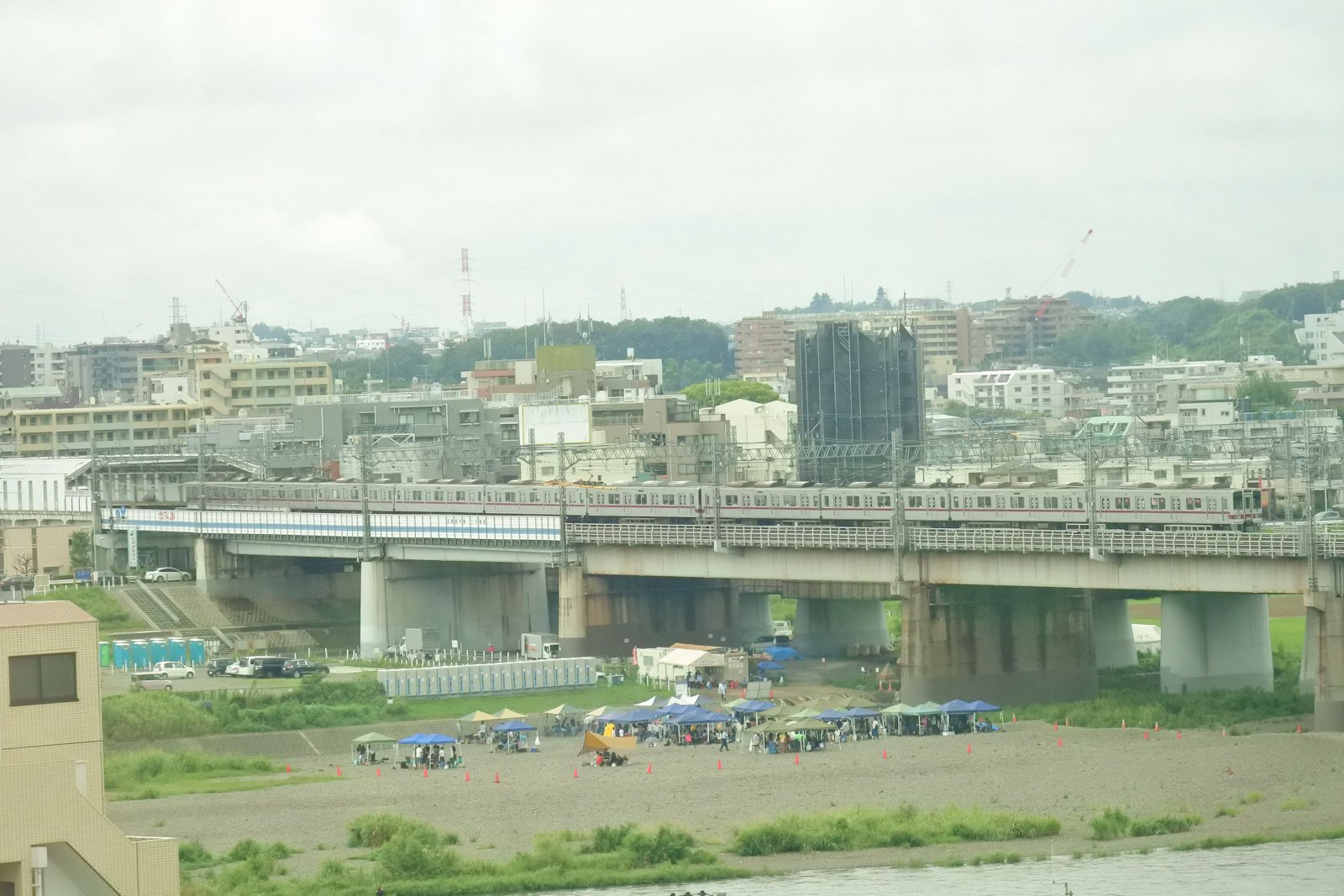
田園都市線・大井町線の列車の撮影を続ける。続いては、撮影場所を二子玉川駅前に広がる二子玉川ライズのルーフガーデン(屋上庭園)へと移す。二子玉川ライズのルーフガーデンは、109シネマズやレストランなどが入居するテラスマーケット部分の3階~5階に広がる複層式の庭園。田園都市線と大井町線の列車が走る姿も見ることができる。まずは5階から多摩川方面を見る位置で、二子新地駅を発車し、多摩川橋梁を渡る田園都市線列車(東武30000系電車)を撮る。二子玉川駅~溝の口駅の区間は「多摩田園都市」ではないが、立ち並ぶマンションを背景に入れて田園都市線の東京23区から郊外へと延びる路線であることを表現し、川原にテントがいくつも並ぶ様子も列車とともに入れて、賑わう休日の多摩川を演出した。2枚目は、4階から大井町線の線路側をテラスマーケットのルーフガーデン(3階)と店舗、ITSCOM STUDIO & HALLを入れて眺める構図で1枚。写真左奥に二子玉川駅へと向かう大井町線列車(東急9000系電車)の姿が見える。写真右奥に見える森は上野毛稲荷神社の鎮守の森と五島美術館の庭園。二子玉川ライズから撮っているということがはっきりと判るようにすることと、東急電鉄・東急グループは鉄道だけではなく街づくりとともに発展してきたということを表すために、列車ではなく二子玉川ライズと街並みを誇張する構図で撮影した。Moving to the multistory roof garden of Futako-tamagawa RISE, consisting of a shopping complex, office buildings, restaurants, a cinema/movie theater, and a hotel, etc., located on its second/third, third/fourth, and fourth/fifth floor in its "Terrace Market" area, I continued photographing trains on Tokyu Den-en-toshi Line and Oimachi Line.The first image is a Den-en-toshi Line train (Tobu 30000 Series) crossing the Tama River with apartment buildings, which symbolises the characteristic that Den-en-toshi Line is a railway connecting between Tokyo metropolitan area and residential area in its suburb, and tents on the river bank, which does the river enjoying the persons coming for their leisure on the holidays, shot at the fourth/fifth floor.The second one is the second/third floor garden and stores with Oimachi Line train (Tokyu 9000 Series) and forest in Kaminoge Inari Shrine and the garden of Goto Museum. Making Futako-tamagawa Rise and the scenery of the city larger than the train, the image expresses that Tokyu Corporation and its group companies have grown not only the railway, but also the city development.
Sep 2, 2018
コメント(0)
-
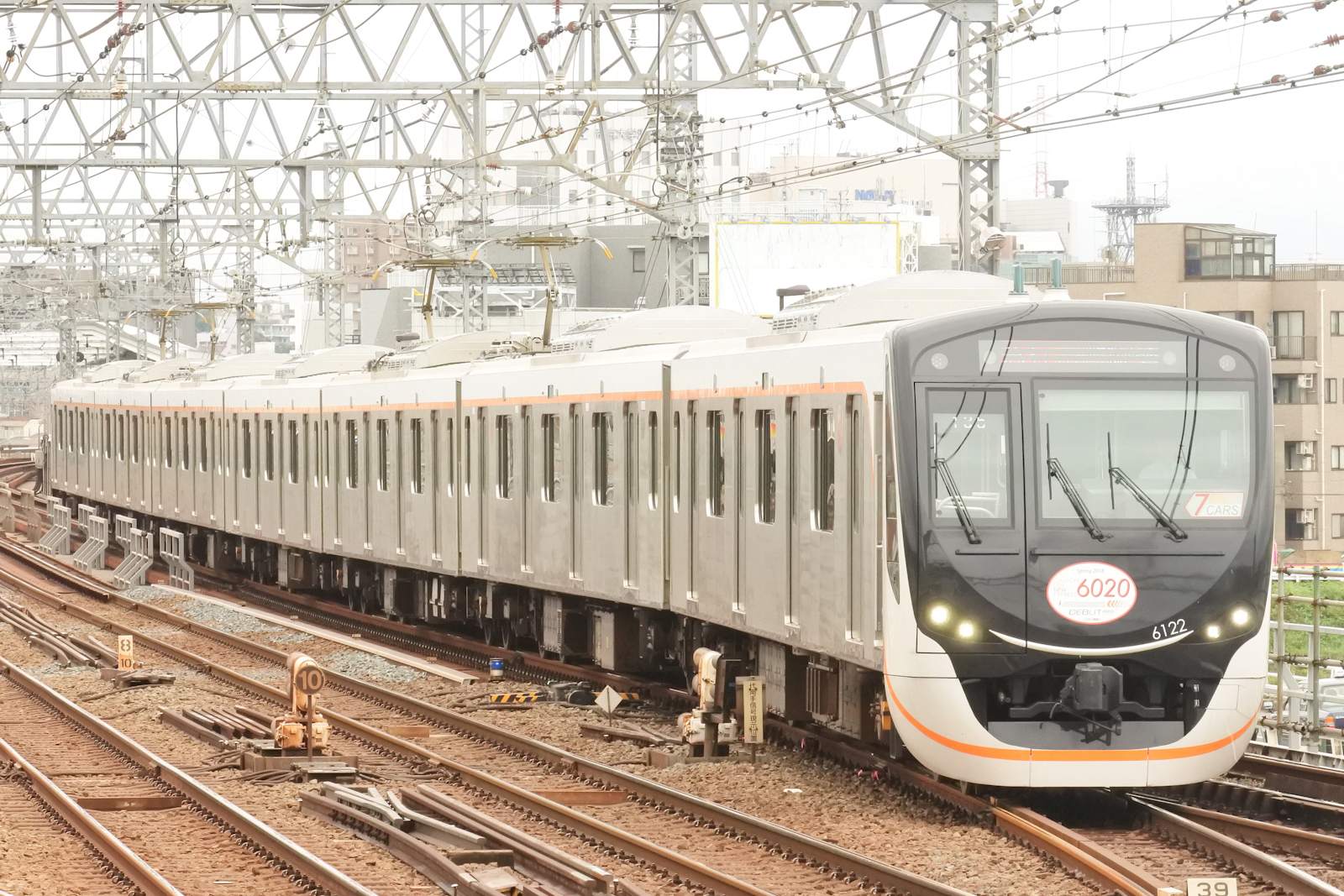
東急6020系電車初撮影
2日、8月19日の東急田園都市線の新型車両である2020系電車に続いて、東急大井町線の新型車両である6020系電車の初撮影に成功した。撮影場所は二子玉川駅ホームの二子新地駅方。2018(平成30)年2月に、田園都市線乗り場(1番線)へのホームドアの設置と同時にホームの最先端よりも手前に柵も設置されたことから、ホーム最先端に立っての撮影ができなくなった。以前よりも不利な撮影条件でありながらも、多摩川橋梁を渡る列車の編成全体を撮ることができた。6020系はとほぼ同一仕様の車両であり、大井町線の急行列車として長津田駅・溝の口駅~大井町駅間で運行されている。2020系と同じく2018(平成30)年3月28日にデビューした。2020系と同様に、僕は撮影は成功したものの乗車したことがないため、近いうちに乗ってみたいとも思っている。On 2nd, I photographed Tokyu 6020 Series, the latest model on Tokyu Oimachi Line, at Futako-tamagawa Station, following 2020 Series on Den-en-toshi Line photographed on August 19th. Though the platform gate and fencing near the end was equipped on February, 2018, and photographers couldn't enter the end of platform, I could photograph whole the train while running on the bridge crossing Tama River.6020 Series, debuted in March 28, 2018, was designed almost the same as 2020 Series and is in service as express trains on Oimachi Line between Nagatsuta Station or Mizonokuchi Station and Oimachi Station.I want to travel with 6020 Series, together with 2020.
Sep 2, 2018
コメント(0)
全17件 (17件中 1-17件目)
1