


2019年07月の記事
全2件 (2件中 1-2件目)
1
-
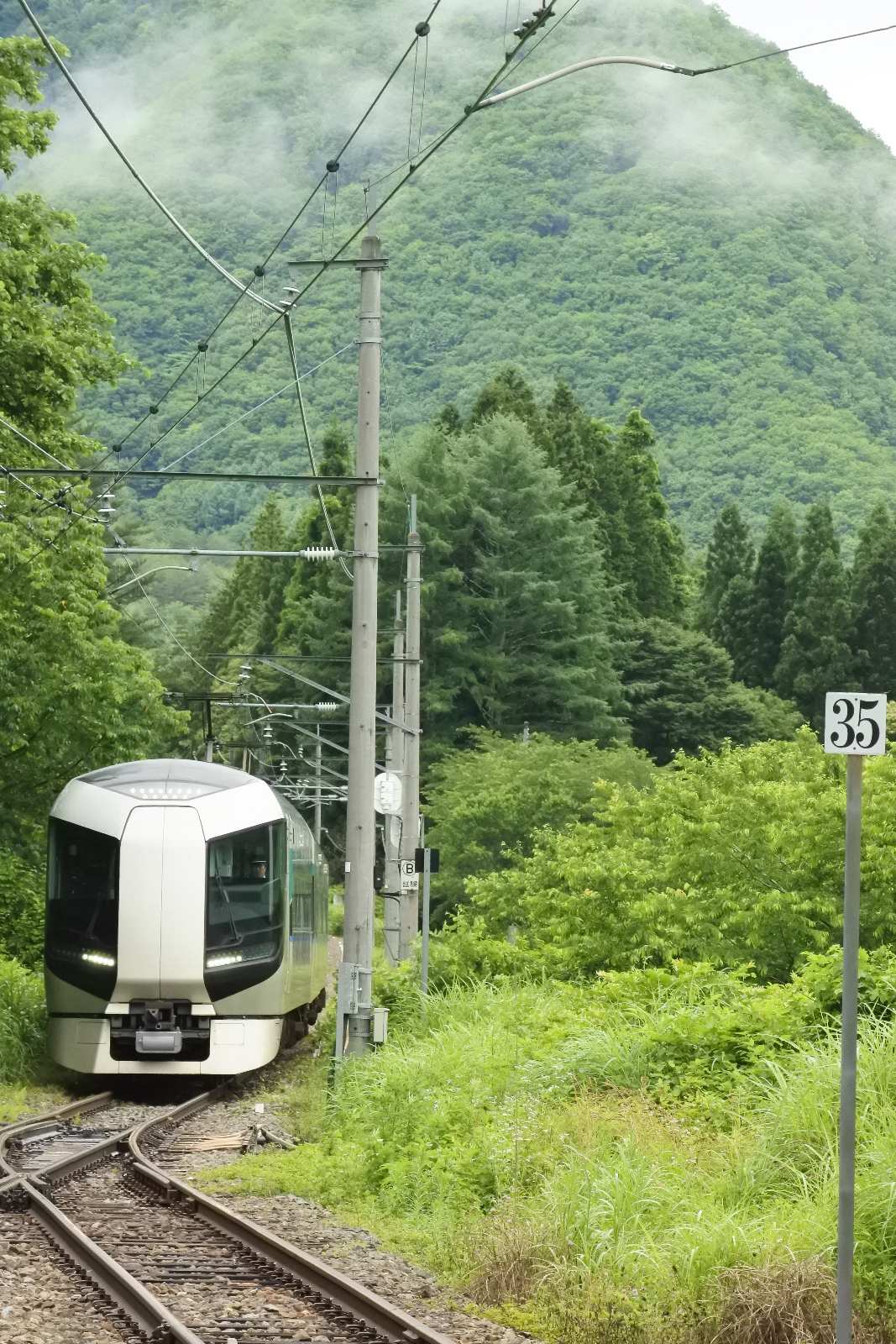
帝釈山脈を越えて 東武500系電車「Revaty」
15日、東武500系電車「Revaty」を撮影。撮影場所は野岩鉄道会津鬼怒川線会津高原尾瀬口駅の男鹿高原方先端の構内踏切付近。荒海山をはじめとする栃木県と福島県の県境にそびえる帝釈山脈の山々を背景に、会津鬼怒川線を走り抜けて福島県へとやって来た「リバティ会津」を捕えた。この日は曇りだったため、山や木々の緑がきれいに撮れるように調整した。帝釈山脈を頂上まで入れずに切り取り、大きく写し出すことで、列車が山間のトンネルを抜けて、東京・浅草から遠路はるばる福島県へとやって来た様子を強調した。関東の大手民鉄の特急列車の中で、東北地方まで運行しているものは「リバティ会津」だけである。「リバティ会津」が運行する以前の2017(平成29)年4月までは、浅草駅からの会津鬼怒川線・会津線直通列車は快速・区間快速列車が主力であり、特急列車は臨時列車を除いて運行していなかった。特急列車とは言っても、「リバティ会津」とかつての快速列車との浅草駅~下今市駅間の停車駅の違いはは板倉東洋大前駅(一部の「リバティ会津」は停車)、新大平下駅、新栃木駅に停車するか否かであり、加えて下今市駅~会津田島駅間では、特急料金なしでも乗れる(ただし座席の指定はできない)快速列車として扱われるため、会津鉄道の快速列車「AIZUマウントエクスプレス」と同様に男鹿高原駅、七ヶ岳登山口駅、会津山村道場駅、会津荒海駅、中荒井駅を通過するか、列車によっては東武の快速列車と同じすべての駅に停車するものもある。そのため、所要時間の大幅な改善とは言いにくい気もするが、東京都内から直通の特急列車が定期運行されることは、会津地方にとっては観光客を呼び込む大きな宣伝効果が期待できると言えるだろう。On 15th, I photographed Tobu 500 Series "Revaty" at Aizukōgen-Ozeguchi Station on Yagan Railway Aizu Kinugawa Line against the Taishaku Mountains rising at the border between Tochigi Prefecture and Fukushima Prefecture.Because of the cloudy day, I set my camera to capture the greenery in a beautiful colour. To feature the train going out of a tunnel into the mountains and coming to Fukushima Prefecture from Asakusa Station, Tokyo, the top of the mountains are trimmed."Revaty Aizu", a limited express train served by 500 Series between Asakusa Station on Tobu SKYTREE Line and Aizu-tajima Station on Aizu Railway Aizu Line, is the only one limited express train on the nine major private railway companies in Kanto Area connecting between Tokyo Metropolitan Area and Tohoku Area. Before the start of "Revaty Aizu" service started in 2017, the limited express train going through Aizu-kinugawa Line and Aizu Line hadn't regularly run and the rapid and section rapid train used to operate.Comparing with the old rapid train, though "Revaty Aizu" is a limited express train, the stopping stations of that is two or three fewer than the stations where the rapid train did between Asakusa Station and Shimo-imaichi Station; Itakura-toyodaimae Station (a partial "Revaty Aizu" stops), Shin-ōhirashita Station, and Shin-tochigi Station passes, and those between Shimo-imaichi Station and Aizu-tajima Station is the same as or six or five stations fewer than that of the rapid train; stopping at all stations, or Tobu World Square Station (one train only), Ojikakogen Station, Nanatsugatake-tozanguchi Station, Aizu-sanson-dōjō Station, Aizu-arakai Station, Naka-arai Station passes. It may be hard to say that it is an improvement of the travel time, but it has big advertising effects that a limited express train directly connect between Tokyo Metropolitan Area and Aizu Area in Fukushima Prefecture to draw more tourists from Tokyo.
Jul 15, 2019
コメント(0)
-
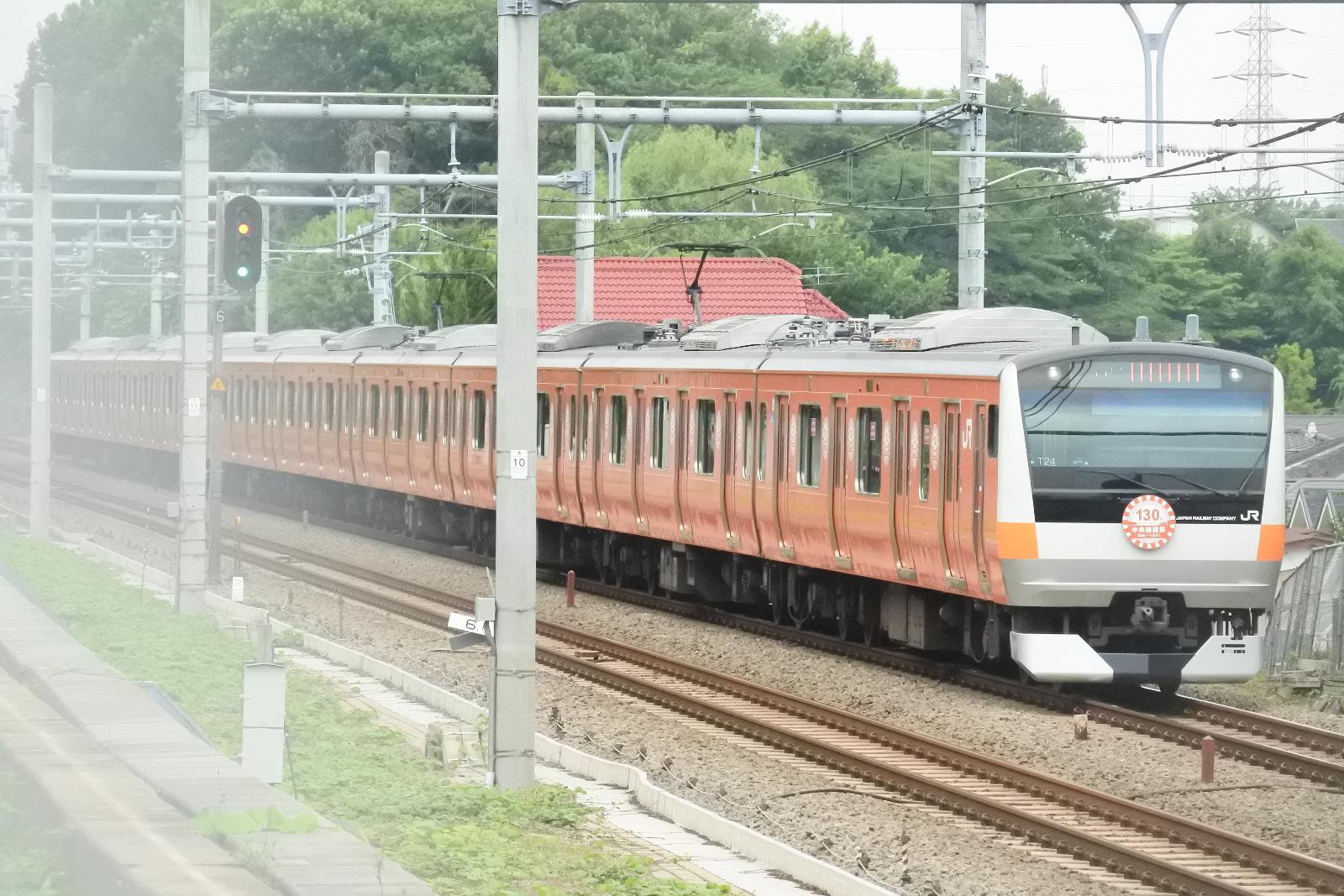
E233系トタT24編成「中央線開業130周年記念ラッピングトレイン」を撮る
6日、JR東日本E233系電車トタT24編成「中央線開業130周年記念ラッピングトレイン」を撮影した。これは2019(平成31・令和元)年に中央線快速の前身である甲武鉄道の開業から130周年を迎えるのを期に同年4月8日から8月31日までの間に運行されている特別ラッピング車両である。1889(明治22)年4月11日に新宿駅~立川駅間が、同年8月11日に立川駅~八王子駅間が開業それぞれ開業した。ラッピングは1979(昭和54)年から2010(平成22)年にかけて活躍した201系電車のJR東日本時代の姿をモチーフにしており、トタT24編成の側面全体を1957(昭和32)年の国鉄101系電車の投入以降中央線快速のラインカラーとして親しまれているオレンジバーミリオン色(朱色1号)で彩っている。西国分寺駅に入線するトタT24編成 E233 Series Tota T24 set about to arrive at Nishi-kokubunji Station西国分寺駅に停車中 E233 Series Tota T24 set stopping at Nishi-kokubunji Station開業130周年記念のロゴマーク Symbol celebrating 130th anniversary for opening of Chuo Line between Shinjuku Station and Hachioji Station車体裾部の形式表記は201系初期車(1979(昭和54)年から1983(昭和58)年にかけて製造された車両)の銀色のステンレス製切り抜き文字をイメージ carriage number on the bottom of the body looking like that of 201 Series西国分寺駅~国分寺駅間を走るトタT24編成 E233 Series Tota T24 set runnnig between Nishi-kokubunji Station and Kokubunji Station僕は2013(平成25)年に山手線で運行された「みどりの山手線50周年」ラッピング車両(E231系電車トウ545編成)を見た時から、山手線以外の国鉄時代に「国電」と呼ばれた東京電車特定区間の通勤路線(中央線快速・京浜東北線)でも、国鉄時代の車両をイメージした側面全体をラインカラーでラッピングした車両が登場することを待ち望んでいた。それだけに、今回の中央線快速のE233系トタT24編成はぜひともその姿を写真に収めたい車両であった。同車のラッピングは、車体色だけでなく、JRマークの色と位置、形式表記のフォントなども、201系の装いをできる限り忠実に再現していると言える。E233系本来の色が残る前面とラッピングの境界を見てみると、同じオレンジバーミリオン色(朱色1号)であっても、ラッピングの車体色とE233系のラインカラーが微妙に違っていることに、僕は気が付いた。京浜東北線における国鉄時代の車両の車体色(青22号)とJR化後の車のラインカラー(青24号)が違うことは知っていたが、中央線快速もよく見ると、国鉄時代とJR化後で車両に使われる色が変化していたことは、意外にもこれまで知らなかった。On 6th, I photographed E233 Series Tota T24 set on Chuo Line rapid service, which has a livery for celebrating 130th opening anniversary of Kobu Railway, the ancestor of Chuo Line, between Shinjuku Station and Hachioji Station in 2019. The livery is designed to look like 201 Series, an old model used to be in service between 1979 and 2010, whose whole of the body side is coloured in the traditional body colour of Chuo Line train, orange vermillion, in Japan National Railway period.Since photographing E231 Series on Yamanote Line having a special livery looking like an old carriage in 2013, I have longed to appear the other carriages having those kinds of liveries on the other lines, such as Chuo Line rapid service or Keihin-tohoku Line.The livery of T24 set resembles that of 201 Series, not only the body colour, but also the place of the JR symbol and the font and colour of the carriage number on the bottom. Watching carefully the border of the special livery and the front in the original colour pattern of E233 Series, I noticed that the line colour of E233 Series differs that of the livery. I know that the colour of the line on the body of E233 Series on Keihin-tohoku Line is lighter than the body colour of the carriage in the JNR period, but I don't know the difference between the two of Chuo Line.
Jul 6, 2019
コメント(0)
全2件 (2件中 1-2件目)
1


-
-
- 模型やってる人、おいで!
- アオシマ 米国海軍爆撃機 ヘルダイ…
- (2026-05-16 05:25:41)
-
-
-

- アニメ・特撮・ゲーム
- 【リゼロ】第72話「ユリウス・ユーク…
- (2026-05-14 10:45:57)
-
-
-
- ポケモンGO
- サンバイザーピカチュウはがんばった…
- (2026-05-15 12:01:31)
-


